







Federal Tax Credits for Heat Pump Upgrades Can Save You Thousands — Here’s What to Know
Federal tax credits for heat pump upgrades are one of the most valuable money-saving tools available to homeowners right now — and most people don’t take full advantage of them.
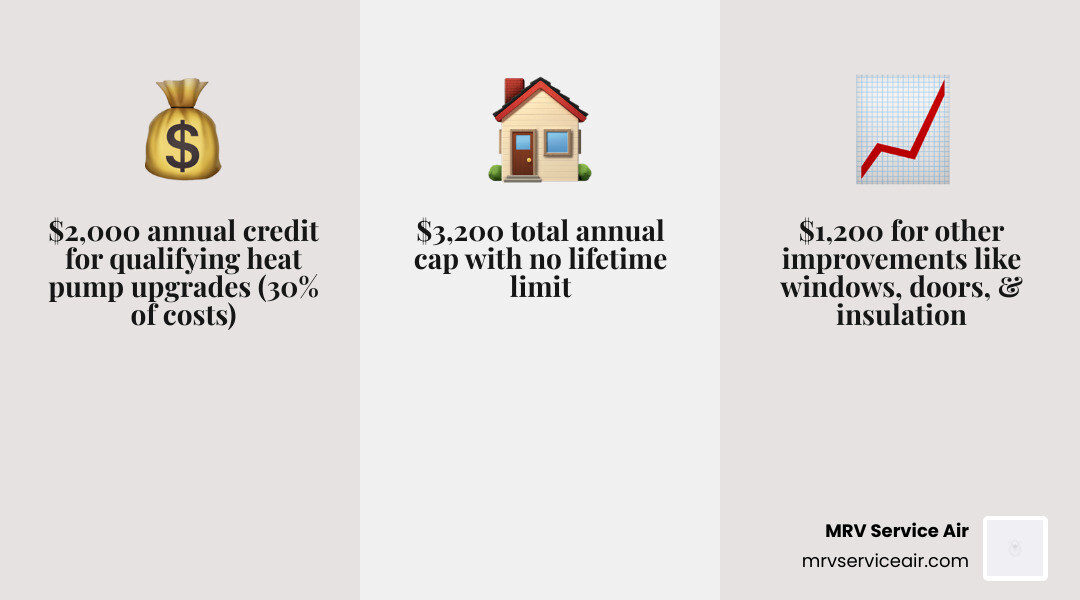
Under the Energy Efficient Home Improvement Credit (Section 25C), part of the Inflation Reduction Act, you can claim 30% of your qualifying heat pump installation costs, up to $2,000 per year. Combined with other eligible improvements, the total annual credit can reach $3,200.
Here’s a quick snapshot of what’s available:
| Improvement Type | Max Annual Credit |
|---|---|
| Air-source heat pumps | $2,000 |
| Other energy improvements (windows, doors, insulation, etc.) | $1,200 |
| Total annual cap | $3,200 |
| Home energy audit | $150 |
Key facts at a glance:
- The credit covers installations completed through December 31, 2025 — claimed on your 2025 tax return, filed in 2026
- The credit is nonrefundable — it reduces your federal tax bill but does not generate a refund
- There is no lifetime dollar limit — you can claim the maximum credit every year you make eligible improvements
- You must install equipment in your primary U.S. residence (some items also qualify for second homes)
- Heat pumps are 3 to 5 times more efficient than most fossil fuel heating systems, with average homeowners saving around $667 per year on energy bills
Most homeowners don’t realize how much is on the table — or that smart planning across multiple years can help them capture the full benefit. The sections below walk you through everything: what qualifies, who’s eligible, what documentation you need, and how to file.
Understanding the Energy Efficient Home Improvement Credit (Section 25C)
The Energy Efficient Home Improvement Credit, often referred to by its tax code name “Section 25C,” is the primary vehicle for these savings. Since January 1, 2023, the federal government has significantly expanded this credit to encourage homeowners to move away from fossil-fuel-burning furnaces and toward high-efficiency electric systems.
When you invest in federal tax credits for heat pump upgrades, you aren’t just getting a “deduction” that lowers your taxable income. You are getting a direct credit that wipes away what you owe the IRS dollar-for-dollar. If you owe $3,000 in federal taxes and you qualify for a $2,000 heat pump credit, your tax bill drops to $1,000.
It is important to note that this is a nonrefundable credit. This means it can reduce your tax liability to zero, but the IRS won’t cut you a check for any “leftover” credit. If you only owe $1,500 in taxes but qualify for the $2,000 credit, you’ll pay $0 in taxes, but you won’t get that extra $500 back as a refund. For more details on how these upgrades fit into a broader home strategy, check out our more info about energy efficiency services.
Annual Credit Caps and Carryovers
Unlike previous versions of this tax credit, which had a $500 lifetime limit, the current law provides an annual limit. This is a game-changer. It means you can potentially claim the credit every single year through 2032 (though the specific 25C heat pump provisions we are discussing are highly focused on the current 2025-2026 filing period).
The caps are broken down into two main buckets:
- The $2,000 Bucket: This is specifically for heat pumps, heat pump water heaters, and biomass stoves.
- The $1,200 Bucket: This covers “building envelope” improvements like windows (capped at $600), exterior doors ($250 per door, $500 total), and insulation. It also covers central air conditioners and furnaces that meet high efficiency standards.
Because these credits do not carry over to future years, if you don’t have enough tax liability to use the full credit this year, you lose the excess. This makes year-by-year planning essential.
Maximizing Federal Tax Credits for Heat Pump Upgrades in 2026
As we move through April 2026, many homeowners are looking back at their 2025 installations to ensure they claim every penny they are owed. Whether you installed a ducted air-source heat pump or a biomass stove, the key is ensuring the equipment meets the rigorous standards set by the IRS.

Heat pumps are the “stars” of this incentive program because they offer the highest individual credit limit. While a new central AC might only net you a $600 credit, a heat pump can get you up to $2,000. If you are considering a switch, you can find more info about heat pump services to see how these systems work in our local climate.
Efficiency Standards for Federal Tax Credits for Heat Pump Upgrades
Not every heat pump qualifies for the credit. The IRS requires that the equipment meet or exceed the highest efficiency tier (not including any “advanced” tiers) established by the Consortium for Energy Efficiency (CEE) that was in effect at the start of the year the equipment was installed.
For 2025 and 2026, this generally means looking for:
- ENERGY STAR Most Efficient certification.
- Specific ratings for SEER2 (Seasonal Energy Efficiency Ratio 2), EER2 (Energy Efficiency Ratio 2), and HSPF2 (Heating Seasonal Performance Factor 2).
For example, in many regions, a split-system ducted heat pump must have a SEER2 of 15.2 or higher to qualify. Ductless systems often require even higher ratings, such as a SEER2 of 16.0. It is vital to consult with a professional to ensure the specific model number you are installing is listed on the CEE Directory or carries a manufacturer’s certification statement. You can learn more info about heating systems to understand how these ratings impact your comfort and your wallet.
Qualifying Equipment for Federal Tax Credits for Heat Pump Upgrades
The tax credit is flexible regarding the type of heat pump technology used. Qualifying systems include:
- Ducted Air-Source Heat Pumps: These use your existing ductwork to distribute air.
- Mini-Split (Ductless) Heat Pumps: Perfect for homes without ducts or for room-specific climate control.
- Cold-Climate Models: Specifically designed to maintain high efficiency even when temperatures drop well below freezing.
For those living in older homes or looking for targeted cooling and heating, you can find more info about ductless HVAC to see if a mini-split qualifies for your $2,000 credit.
Eligibility Requirements for Homeowners and Renters
To claim the credit, the heat pump must be installed in a home located in the United States that you use as a residence.
- Principal Residence: Most improvements, including home energy audits and weatherization (like insulation), must be installed in your primary home.
- Second Homes: Interestingly, for “residential energy property” like heat pumps and heat pump water heaters, you can claim the credit for a second home that you use as a residence. However, you cannot claim the credit for a property that you rent out and do not live in yourself.
- Renters: If you are a renter and you pay for a qualifying upgrade to your primary residence (with the landlord’s permission), you may actually be eligible to claim the credit.
For those in the Central Iowa area, whether you’re in Des Moines, Ankeny, or Waukee, these federal rules apply uniformly. If you’re unsure if your home type qualifies, more info about central HVAC services can help clarify standard installation types.
Property Types and Business Use
The credit isn’t just for traditional detached houses. It also applies to:
- Mobile homes
- Condominiums
- Cooperatives
- Manufactured homes
There is a specific rule regarding business use. If you use your home partly for business (for example, a home office), the credit is usually limited. If the business use is less than 20%, you can claim the full credit. If business use exceeds 20%, the credit is allocated based on the percentage of the home used for residential purposes. Working with a qualified HVAC contractor ensures that your installation is documented correctly regardless of your property type.
How to Claim Your Credit: Documentation and IRS Form 5695
Claiming your credit happens when you file your federal income tax return. You will use IRS Form 5695, Residential Energy Credits, specifically Part II.
For 2025 installations (the ones being filed now in 2026), there is a new and critical requirement: the Qualified Manufacturer Identification Number (QMID) or a Product Identification Number (PIN). Starting in 2025, the IRS requires this code to be included on your tax return for the product to be eligible. You cannot simply claim “a heat pump”; you must provide the specific code provided by the manufacturer.
If you are upgrading an older system, such as an aging furnace, you can find more info about furnace services to help you decide when the right time is to switch to a tax-credit-eligible heat pump.
Required Records for 2026 Filings
Don’t wait until tax season to go hunting for paperwork. You should keep a “tax credit file” that includes:
- The Receipt: Showing the total cost, including labor. Unlike some other credits, the 25C credit for heat pumps does include the cost of installation labor.
- Manufacturer Certification Statement: A signed document from the manufacturer certifying that the specific model meets the required efficiency Tiers.
- QMID/PIN: The unique 2025/2026 identification code for your specific unit.
- Electrical Upgrade Receipts: If you had to upgrade your electrical panel to support the new heat pump, that cost may qualify for a separate $600 credit.
Proper documentation is also key if you’ve had to perform duct work to make your new system work efficiently.
Combining Federal Credits with California Energy Rebates
One of the best things about the Inflation Reduction Act is that it allows “stacking.” You can often combine the federal tax credit with state-level rebates or utility company incentives.
In many cases, states offer programs like the High-Efficiency Electric Home Rebate Act (HEEHRA), which can provide point-of-sale discounts for low-to-moderate-income households. However, there is a catch: if you receive a rebate that is considered a “purchase price adjustment,” you must subtract that rebate from the total cost of the project before calculating your 30% tax credit.
For example, if a heat pump installation costs $10,000 and you get a $2,000 state rebate at the time of purchase, your “qualified cost” for the federal tax credit is $8,000. 30% of $8,000 is $2,400, but since the heat pump credit is capped at $2,000, you would claim the full $2,000. For the latest local opportunities, check our more info about specials and rebates.
Strategies for Multi-Year Upgrades
Since the $3,200 limit resets every year, the smartest homeowners are “sequencing” their projects.
Year 1: Get a home energy audit ($150 credit) and upgrade your attic insulation and air sealing (up to $1,200 credit). This “tightens” the home so you don’t need as large (or expensive) a heat pump later. Year 2: Install your air-source heat pump (up to $2,000 credit) and perhaps upgrade your electrical panel ($600 credit). Year 3: Replace your old water heater with a high-efficiency heat pump water heater (another $2,000 credit).
By spreading these out, you can capture thousands more in tax savings than if you did everything at once. This requires some planning and design, but the payoff is significant.
Frequently Asked Questions about Heat Pump Tax Credits
Can I claim the credit for a heat pump in a rental property I own?
Generally, no. The Section 25C credit is for homes used as a residence by the taxpayer. If you are a landlord and do not live in the property, you cannot claim this specific credit. However, there may be other commercial tax incentives available for business owners.
Is the $2,000 heat pump credit available every year?
Yes! Under the current law, the $2,000 annual limit for heat pumps and heat pump water heaters resets every calendar year. If you install a heat pump in your main home this year and a heat pump water heater in your second home next year, you can claim the credit both times.
Do I need to itemize my deductions to receive the credit?
No. You do not need to itemize your deductions to claim the Energy Efficient Home Improvement Credit. It is a “standard” credit that is added to your tax return regardless of whether you take the standard deduction or itemize.
Conclusion
Upgrading to a heat pump is one of the most impactful moves you can make for your home’s comfort and your long-term energy bills. With the federal tax credits for heat pump upgrades providing up to $2,000 in immediate tax relief, the financial barrier to electrification has never been lower.
At All Seasons HVAC LLC, we take pride in helping our neighbors in Des Moines, Ankeny, and throughout Central Iowa navigate these complex incentives. We provide prompt, quality service at affordable prices, ensuring your new system not only qualifies for the maximum tax credit but also provides reliable comfort for years to come.
Don’t leave money on the table this tax season. Schedule your energy-efficient upgrade today and let us help you maximize your savings while improving your home comfort.