







Why Every Farm Manager Needs an HVAC Maintenance Checklist for Hot Agricultural Climates
Following an hvac maintenance checklist for hot agricultural climates is one of the most important things you can do to keep your facility running when temperatures push past 110°F. Here are the core tasks to prioritize:
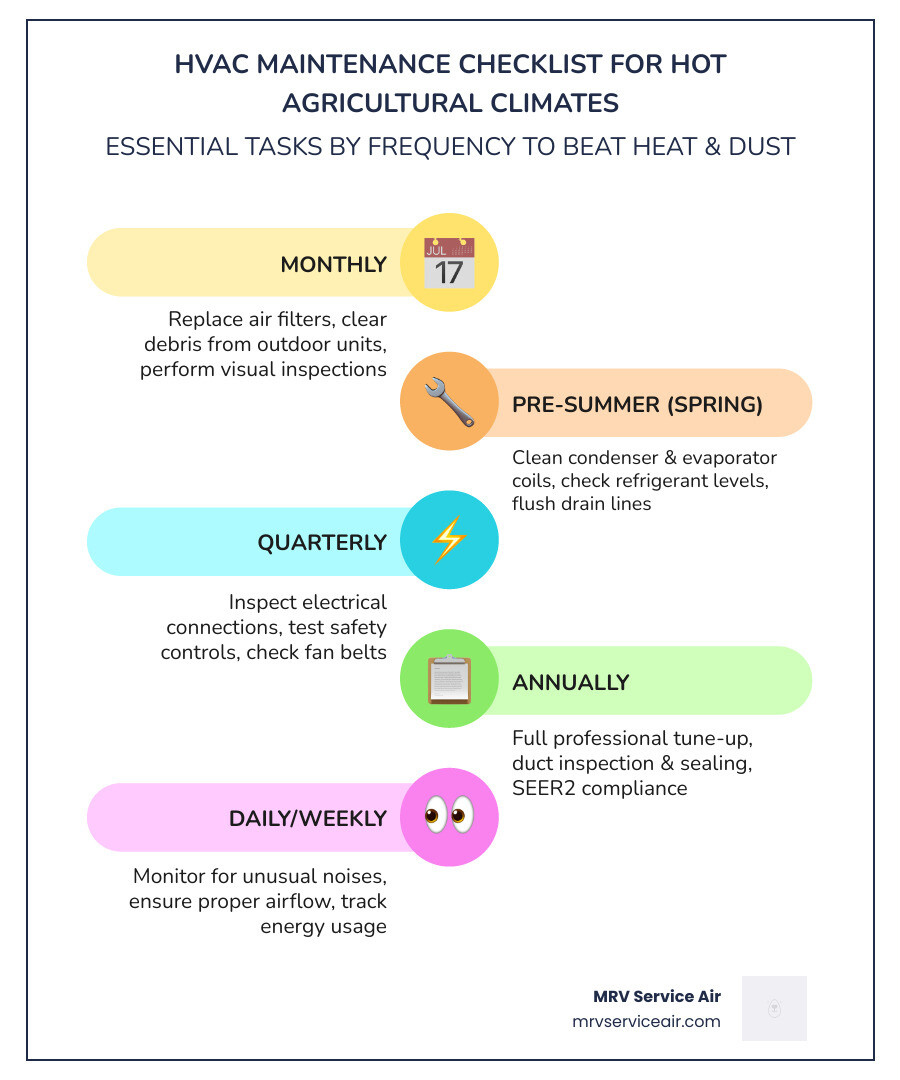
Quick-Reference HVAC Maintenance Checklist for Hot Agricultural Climates:
- Monthly – Replace air filters, clear debris from outdoor units, run visual inspections
- Pre-Summer (Spring) – Clean condenser and evaporator coils, check refrigerant levels, flush condensate drain lines, calibrate thermostats
- Quarterly – Inspect electrical connections, test safety controls, check fan belts and moving parts
- Annually – Full professional tune-up, duct inspection and sealing, refrigeration unit check, SEER2 compliance review
If you operate a farm, packing house, greenhouse, or livestock facility in California’s Central Valley, your HVAC system is fighting a battle every single day. It’s not just the heat — though temperatures here routinely top 110°F for weeks at a stretch. It’s the combination of that brutal heat and the fine agricultural silt that drifts in from nearby fields, coats your coils, clogs your filters, and quietly grinds your equipment down from the inside out.
One source puts it bluntly: a neglected HVAC unit in this kind of environment can fail in as little as 10 years, while a properly maintained system can last 25. That gap isn’t bad luck — it’s the direct result of skipped maintenance during seasons when the stakes are highest.
Regular preventive maintenance can cut the risk of a major equipment breakdown by up to 95%, and clean air filters alone can trim energy consumption by as much as 15%. In an agricultural operation where cooling is tied directly to crop quality, product storage, worker safety, and livestock health, those numbers aren’t just interesting — they’re the difference between a good season and a costly disaster.
This checklist is built specifically for the demands of hot agricultural environments. Whether you’re managing a multi-acre indoor farm, a produce cooler, or a farm office in Kern County, here’s exactly what to inspect, when to do it, and why it matters.
Why HVAC Maintenance is Critical in Hot Agricultural Climates
In the Central Valley, the environment is uniquely hostile to mechanical systems. When we hit May 2026, we are looking at ambient temperatures that frequently hover around 110°F. At these temperatures, the air conditioning units on your farm aren’t just working; they are running a marathon at a sprint pace.
The primary enemy of any HVAC system in Delano or Bakersfield is the combination of extreme thermal load and agricultural silt. Unlike city dust, agricultural dust is often finer and more abrasive. It acts like sandpaper on moving parts and like a thick wool blanket on your condenser coils. Understanding why the Valley’s dust and heat are your AC’s worst enemies is the first step in protecting your investment.
When dust coats a condenser coil, it provides insulation. Normally, the coil’s job is to release heat from the refrigerant into the outside air. If it’s covered in silt, that heat stays trapped. Your compressor has to work twice as hard to achieve the same cooling effect, leading to skyrocketing energy bills and a significantly shortened equipment lifespan. Furthermore, the dirty truth about agricultural dust and indoor air is that it doesn’t just stay outside; it infiltrates your packing sheds and offices, compromising both machinery and worker health.
The Essential HVAC Maintenance Checklist for Hot Agricultural Climates
To stay ahead of the heat, we recommend a tiered approach to maintenance. A “set it and forget it” mentality will lead to a system “buying the farm” right when you need it most—usually in the middle of a July harvest.
| Frequency | Key Tasks | Primary Benefit |
|---|---|---|
| Monthly | Filter changes, debris clearing, visual inspection | Maintains airflow & reduces fire risk |
| Seasonal | Coil cleaning, drain flushing, thermostat calibration | Prevents mid-season breakdowns |
| Annual | Electrical tightening, refrigerant check, duct sealing | Maximizes lifespan & energy efficiency |
By following a structured hvac maintenance checklist for hot agricultural climates, you transition from reactive repairs to proactive management. This is especially vital for Central Valley AC readiness where the cooling season can last six months or longer.
Monthly HVAC maintenance checklist for hot agricultural climates
Monthly tasks are your first line of defense. In a farm environment, a “standard” three-month filter schedule is a recipe for disaster.
- Filter Replacement: During peak harvest or tilling season, check your filters every 30 days. We have seen filters in Shafter and Wasco completely clogged in just three weeks of heavy field activity. Choosing the top air filter picks for farm environments—usually something with a MERV 8 to 11 rating—can balance the need for filtration with the need for high airflow.
- Debris Removal: Walk around your outdoor units. Ensure there is at least a two-foot clearance of weeds, tall grass, or equipment. In agricultural settings, tumbleweeds or loose plastic mulch can easily get sucked against the intake, choking the system.
- Visual Inspections: Look for frayed wires or signs of pests. Rodents love the shade and protection of an HVAC cabinet and can quickly chew through a seasonal’s worth of wiring. If you have pets on the farm, a filter change schedule for furry friends needs to be even more aggressive.
Seasonal HVAC maintenance checklist for hot agricultural climates
Seasonal prep should happen in early Spring, before the first 90-degree day hits. This is the “tune-up” phase that determines how well your system handles the 110°F “marathon” ahead.
- Evaporator and Condenser Cleaning: Use a dedicated coil cleaner to remove the baked-on silt. Water alone often isn’t enough to cut through the grime found on a farm.
- Refrigerant Levels: Low refrigerant is a leading cause of compressor failure. It’s not a consumable—if it’s low, there’s a leak. Identifying how often to schedule tune-ups ensures these leaks are caught before the system freezes up.
- Condensate Drain Flushing: High humidity in greenhouses or packing houses leads to a lot of condensation. Algae can grow in these lines, causing backups that lead to water damage. A simple flush with a vinegar solution can prevent this.
- Thermostat Calibration: Ensure your sensors are reading accurately. In a large facility, a thermostat that is off by just 3 degrees can result in hundreds of dollars of wasted energy per month. For more details, check our guide on maintaining AC in extreme heat and dust.
Managing Dust, Humidity, and Airflow for Crop Success

In indoor agriculture, your HVAC system is more than a comfort provider—it is a life-support system for your crops. Different plants have vastly different requirements. For example, leafy greens thrive in much cooler, crisper air than tomatoes or peppers. If your airflow isn’t balanced, you’ll end up with “micro-climates” or hot spots in your greenhouse that can lead to uneven growth or crop stress.
Dust management is the “survival guide” for these systems. Valley dust vs. your HVAC is a constant struggle. High-efficiency filtration is necessary to prevent airborne pests and mold spores from circulating. However, these thick filters can restrict airflow if not monitored, leading to frozen coils.
Humidity control is equally vital. In the irrigated fields of Kern and Tulare counties, humidity can spike unexpectedly. Without proper dehumidification, you invite mold and mildew. Conversely, if the air is too dry, crops will transpire too quickly and wilt. Integrating CO2 regulation into this mix is a delicate dance; the system must circulate enough air to keep plants healthy without venting out all the expensive CO2 enrichment. For specialized needs, our indoor air quality services in Delano can help design a filtration and ventilation plan that protects your yield.
Specialized Refrigeration and Livestock Cooling Protocols
For many of our clients in Porterville and Earlimart, the HVAC system also includes commercial refrigeration for produce storage or cooling rooms for livestock. These systems face even higher stakes. If a produce cooler fails, you lose the entire harvest.
- Cold Ambient Controls: These are essential for refrigeration units located outdoors. They help balance the system when there is a massive temperature difference between the 110°F outdoor air and the 35°F interior of the cooler.
- Gasket Integrity: Check the seals on your walk-in doors. A cracked gasket is like leaving a window open in the middle of summer. It lets the cold air out and forces the compressor to run 24/7.
- Livestock Heat Stress: In dairy or poultry operations, cooling is a matter of animal welfare. Misters and high-velocity fans must be integrated with the HVAC controls to ensure that if the temperature hits a certain threshold, the cooling kicks in immediately.
Regular commercial refrigeration maintenance should include checking defrost cycles and monitoring compressor “cycling” patterns. If the compressor is turning on and off every few minutes (short-cycling), it’s a sign of a major problem brewing.
Maximizing Efficiency and Equipment Lifespan in 2026
Energy efficiency isn’t just a buzzword; it’s a financial necessity. Commercial buildings and agricultural facilities can waste up to 33% of their energy due to poor maintenance and leaky ductwork. By improving efficiency by just 10%, you can significantly slash your CO2 emissions and utility costs.
As of 2026, SEER2 standards are the benchmark for efficiency. If your equipment is more than 10-15 years old, it likely has a SEER rating that is costing you a fortune in wasted power. We provide energy efficiency services in Delano to help you audit your current usage and identify where you’re losing money.
For larger operations, we recommend using CMMS (Computerized Maintenance Management System) software or asset tracking tags. These tools allow you to scan a code on an HVAC unit and see exactly when the filter was last changed and who performed the last tune-up. This level of organization is how you ensure that nothing on your hvac maintenance checklist for hot agricultural climates falls through the cracks. If you’re looking for affordable AC maintenance in Kern, focusing on efficiency is the best way to see a return on your investment.
Frequently Asked Questions
What are the signs of HVAC heat stress in agricultural settings?
Heat stress usually manifests as a gradual decline in performance before a total failure. Look for:
- Weak Airflow: Often caused by a clogged filter or a failing blower motor.
- Frequent Short-Cycling: The unit turns on and off rapidly, which is often a sign of overheating or refrigerant issues.
- Unusual Noises: Grinding or squealing can indicate that dust has gotten into the bearings.
- Ice on the Lines: Even in 110°F heat, a system can freeze up if the airflow is restricted or refrigerant is low. For more troubleshooting, see our Porterville AC maintenance 101 guide.
What safety protocols should be followed during farm HVAC maintenance?
Safety is paramount when working on heavy agricultural machinery.
- Lock Out/Tag Out (LOTO): Always disconnect the power at the breaker before opening an HVAC cabinet.
- PPE: Wear gloves and eye protection, especially when using chemical coil cleaners or handling refrigerants.
- Hydration: If you are performing DIY maintenance in the heat, drink at least an ounce of water every 15 minutes.
- Electrical Safety: Check for charred wires or loose connections which are common fire hazards in dusty environments. If you’re unsure, it’s always safer to call for AC maintenance in Earlimart.
How does dust impact HVAC performance on a farm?
Dust is the “silent killer” of HVAC systems. It creates an insulation effect on coils, preventing heat transfer. It also increases friction in moving parts, leading to premature motor failure. Clogged filters force the system to work harder, which can lead to a $5,000 compressor replacement that could have been avoided with a $20 filter. Don’t let the silt win; stay on top of your AC maintenance in Richgrove to keep your energy bills under control.
Conclusion
Running an agricultural operation in the Central Valley is hard enough without having to worry about your cooling systems failing in the middle of a heatwave. At MRV Service Air, we’ve spent years helping farmers and facility managers in Delano, Bakersfield, and the surrounding areas keep their equipment running through the toughest conditions.
Our team provides prompt, quality service at affordable prices, ensuring that your hvac maintenance checklist for hot agricultural climates is handled by experts who understand the local challenges of heat and silt. Whether you need a quick filter change or a full system overhaul, we are here to help.
Schedule your professional AC service in Delano and Bakersfield today and make sure your AC doesn’t buy the farm this summer.