







Why Fog Season Humidity Is a Real Mold Threat for Valley Homeowners
How fog season humidity creates mold risk in the valley is something many Central Valley homeowners don’t think about until they smell something musty or spot a dark patch on the wall. But by then, the problem is often already well underway.
Here’s the short answer:
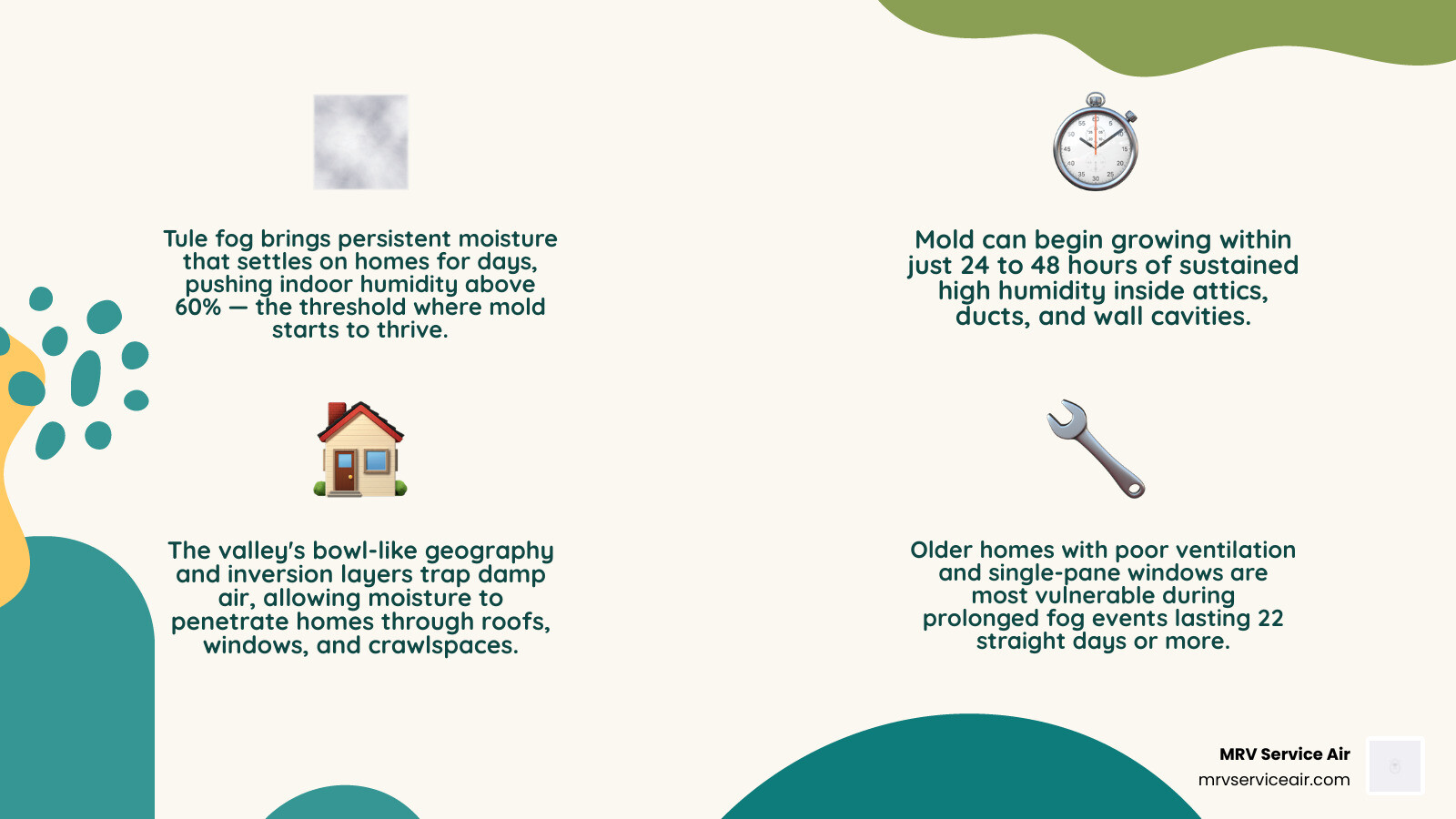
- Tule fog brings persistent moisture that settles on and inside homes for days at a time
- Indoor humidity levels can climb above 60% during prolonged fog — the threshold where mold begins to thrive
- Mold can start growing within just 24 to 48 hours of sustained high humidity
- The most dangerous growth often hides in attics, ductwork, wall cavities, and crawlspaces where you can’t easily see it
- Older homes with poor ventilation and single-pane windows are especially vulnerable
- HVAC systems that aren’t properly maintained can spread moisture and spores throughout the home
Sacramento issued nine dense fog advisories in a single November — the most since at least 2005. In one December, the Central Valley saw 22 straight days of fog, the longest run since the 1970s. That’s not just a weather story. For homeowners, it’s weeks of trapped moisture, saturated building materials, and ideal conditions for mold to take hold quietly behind walls and above ceilings.
The Central Valley’s geography makes this worse. The valley acts like a bowl. Cold, damp air settles at the bottom and stays there, held in place by a layer of warmer air above — what meteorologists call an inversion layer. There’s nowhere for the moisture to go. And that means it goes into your home instead.
Why How Fog Season Humidity Creates Mold Risk in the Valley Is Different in Sacramento and the Central Valley
In the Central Valley, we are used to extreme weather, but the “fog season” is a unique beast. Unlike the coastal fog that rolls in and out of San Francisco, our Tule fog is a homegrown phenomenon. It stays. It lingers. And because our geography acts like a giant granite bowl, it creates a localized moisture crisis that you won’t find in the desert or the mountains.
How Sacramento’s Mediterranean Climate Sets Up Winter Moisture Problems
Our Mediterranean climate is famous for bone-dry summers, which is why we often forget about moisture. However, as the calendar turns toward May 2026, we’ve seen how those damp winters can catch people off guard. When the ground is saturated by autumn rains and the nights grow long, the air cools rapidly. This cooling reaches the “dew point,” where water vapor turns into liquid.
On cold mornings, this moisture doesn’t just stay on the grass. It condenses on your roof, your siding, and even the inside of your windows. Because Sacramento and the surrounding valley experience such significant temperature swings between day and night, your home is constantly “sweating,” providing the perfect hydration for mold spores.
How Tule Fog Traps Moisture Near Homes for Days or Weeks
Tule fog is scientifically known as radiation fog. It forms on calm, clear nights after rain. In places like Delano, Bakersfield, and Porterville, a high-pressure system often acts as a “lid,” trapping this moisture near the ground.
When the valley experienced 22 consecutive days of fog recently, it wasn’t just a visibility issue for drivers. It meant that for over three weeks, the outdoor relative humidity was nearly 100%. This persistent moisture eventually migrates indoors. If your indoor humidity levels stay above 60% for more than two days, you aren’t just living in a house; you’re living in an incubator for mildew. This is exactly how fog season humidity creates mold risk in the valley—by providing a never-ending supply of water to spores that would otherwise stay dormant.
How Urban Heat Island and Delta Breeze Shift Indoor Humidity
Even within the valley, the risks vary. In downtown areas, the “urban heat island” effect can keep temperatures up to 8°F higher than in rural areas. This sounds like it would dry things out, but it actually creates a “suction” effect that pulls in the damp Delta Breeze. These sudden humidity swings force your HVAC system to constantly adjust. This cycle of heating and cooling can lead to condensation inside your ductwork, creating a hidden swamp that is invisible to the naked eye.
The Hidden Moisture Patterns That Push Homes Into Mold Territory
Mold is a silent opportunistic guest. It doesn’t need a massive flood to move in; it just needs a little bit of “window sweat” and a lack of airflow. Once the humidity in your home crosses that 60% threshold, the clock starts ticking.

The Humidity Levels and Daily Patterns Most Likely to Trigger Growth
The danger zone begins when indoor relative humidity consistently stays above 50%, but 60% is the “ignition point” for most common household molds. During the peak of fog season, morning saturation is the biggest threat. As the air outside cools, the surfaces of your home—like window frames and outer walls—become cold. When your warm indoor air touches these cold surfaces, it drops its moisture. This “thermal bridging” creates a repeated wetting cycle every single night, which is plenty of time for mold to grow within 24 to 48 hours.
The Most Common Hidden Mold Locations During Fog Season
Visible mold is often just the tip of the iceberg—representing only about 10% of the actual contamination. Here are the hotspots we frequently see in Kern and Tulare counties:
- Attics: Moist air from your bathroom or kitchen rises and hits the cold underside of your roof, causing “attic rain.”
- Ductwork: If your ducts have even minor leaks, they pull in damp, foggy air from the attic or crawlspace.
- Closets: Especially those on exterior walls where there is zero airflow.
- Behind Furniture: Large couches pushed against cold walls trap moisture and prevent the wall from drying.
- Window Frames: Water pools in the tracks of single-pane windows and seeps into the drywall.
- Crawlspaces: The damp valley soil releases moisture directly into the floor joists.
Why Older Valley Homes and Poor Ventilation Make Everything Worse
Many homes in older neighborhoods of Bakersfield or Shafter were built before modern moisture barriers were standard. Single-pane windows are notorious for “sweating” during the Tule fog. Furthermore, many older homes have “attic bypasses”—small gaps around light fixtures or plumbing stacks—that let warm, moist air escape into the attic. When you combine this with blocked soffit vents or poor bathroom exhaust fans that vent into the attic rather than outside, you’ve created a recipe for structural rot.
How HVAC Systems Can Raise or Reduce Mold Risk During Foggy Weather
Your HVAC system is your home’s lungs. During fog season, it can either be your best defense or your biggest liability. If you’re concerned about your home’s air quality, it might be time to look at indoor air quality services to ensure your system is helping rather than hurting.
How Dirty Filters, Duct Leaks, and Wet Components Spread Moisture and Spores
When your HVAC system runs during a foggy stretch, it’s processing incredibly damp air. If your filters are clogged with valley dust, they can actually hold onto moisture, becoming a damp mat where mold can grow.
Even worse is the dirty truth about your air ducts and mold risk. If you have duct leaks, the system can pull in spores from the attic or crawlspace and blast them into every room in the house. In heat pump systems, the outdoor coils can even freeze during heavy fog, leading to frequent defrost cycles that stress the system and can lead to internal rust and microbial buildup.
What HVAC Features Help Prevent Mold During Tule Fog Season
Modern technology has given us some great tools to fight back. A whole-home dehumidifier can be integrated into your existing system to keep your indoor air at a crisp 45% humidity, regardless of how thick the Tule fog is outside.
Using the “fan” setting on your thermostat can also help by keeping air moving, which prevents the stagnant, damp pockets where mold loves to start. We also recommend ventilation work to ensure your home is breathing correctly. Investing in energy efficiency services can help seal those attic bypasses, keeping the moisture where it belongs—outside.
Why Dust, Agricultural Particles, and Duct Contamination Matter in Valley Homes
In our part of the world, we don’t just deal with moisture; we deal with agricultural dust and indoor air issues. Dust particles act as “seeds” for mold spores. When the fog is thick, it traps these particles close to the ground.
This valley dust vs your HVAC battle is year-round, but it hits a peak in winter. To protect your family, you should breathe easy near the farm with these top air filter picks, such as MERV 13 filters, which are dense enough to catch both the moisture-laden dust and the microscopic spores themselves.
Wildfire Smoke, Fog, and Mold: The Indoor Air Quality Problem Many Homeowners Miss
A trend we’ve noticed in recent years is the overlap of late-season wildfire smoke and early-season Tule fog. This creates a “smog-fog” that is particularly dangerous for indoor air quality.
How Smoke and Fog Together Affect Indoor Surfaces and HVAC Systems
Wildfire smoke leaves behind a sticky, microscopic residue. When this soot combines with the high humidity of the Tule fog, it creates a damp, nutrient-rich film on your HVAC coils and inside your ducts. This “gunk” is essentially mold food. It also clogs high-efficiency filters much faster than normal dust, forcing your system to work harder and potentially pulling more damp air through the cracks in your home’s envelope.
| Trigger | Source | Impact on Home |
|---|---|---|
| Smoke Particulates | Wildfires | Clogs filters, creates sticky residue on coils |
| Fog Moisture | Tule Fog | Raises humidity, causes window & attic condensation |
| Mold Spores | Natural Environment | Thrives in 60%+ humidity, spreads via ducts |
Health Risks of Mold Exposure During Prolonged Foggy Weather
Living in a damp, moldy home isn’t just unpleasant; it’s a health risk. Many residents in the Delano and Bakersfield areas mistake mold symptoms for a “winter cold” or lingering seasonal allergies. Common signs include:
- Persistent coughing or wheezing
- Chronic sinus congestion
- Eye irritation and redness
- Skin rashes or hives
- Unusual fatigue or “brain fog”
For children, the elderly, or those with asthma, these symptoms can become severe very quickly during a long foggy stretch.
What Homeowners Should Do Before and During Fog Season
Prevention is always cheaper than remediation. Taking a few hours to prep your home in the fall can save you thousands of dollars in mold cleanup come spring.
Pre-Fog Season Maintenance That Lowers Mold Risk
Before the first dense fog advisory hits, do a walk-through of your home. Check your roof for missing shingles and ensure your gutters are clear; water pooling at the foundation is a major source of crawlspace moisture.
Most importantly, schedule a bi-annual tune-up. Whether you need furnace services or heat pump services, a professional can spot the early signs of rust, moisture buildup, or duct leaks before they turn into a mold colony.
During Fog Season: Daily Habits That Keep Humidity Under Control
When the fog rolls in, change your habits:
- Run the exhaust fans: Keep the bathroom fan on for at least 20 minutes after a shower.
- Wipe the windows: If you see condensation on your glass, wipe it down immediately. Don’t let it soak into the wooden frame or drywall.
- Monitor the air: Buy a cheap hygrometer to track your indoor humidity. If it stays above 50%, it’s time to act.
- Give your home space: Pull furniture a few inches away from exterior walls to allow air to circulate.
When to Call for Professional Help
If you notice a persistent musty smell, see dark spots on your ceiling, or find that your family’s respiratory issues vanish when you leave the house but return when you get home, you likely have a mold problem.
At MRV Service Air, we specialize in cultivating clean air solutions for rural homes. We can help you identify moisture sources and implement filtration strategies that keep your air safe.
Frequently Asked Questions About How Fog Season Humidity Creates Mold Risk in the Valley
Is it safe to run heating or AC during heavy Tule fog?
Yes, it is actually recommended. Running your system helps circulate the air and, depending on your setup, can help remove excess moisture. Just ensure your filters are clean so you aren’t circulating trapped pollutants.
Where does mold usually start if I cannot see any water leak?
Mold often starts in the attic or inside wall cavities where warm indoor air meets a cold exterior surface. Closets on the north side of the house are also prime targets because they stay cooler and have very little air movement.
What indoor humidity should valley homeowners aim for in winter?
Ideally, you want to keep your home between 30% and 50% humidity. Once you cross 60%, the risk of mold growth increases exponentially.
Conclusion
The Central Valley is a beautiful place to live, but our unique weather patterns require a unique approach to home maintenance. Understanding how fog season humidity creates mold risk in the valley is the first step toward protecting your property and your health. By staying proactive with your HVAC maintenance and keeping a close eye on your indoor moisture levels, you can keep the Tule fog where it belongs—outside.
If you’re worried about your home’s air quality this winter, don’t wait for the musty smell to start. Contact us today to learn more about our indoor air quality services and let us help you breathe easy all season long.