







I’m concerned about the air quality in my house. Can anyone explain air filter types and MERV ratings for my Des Moines home?
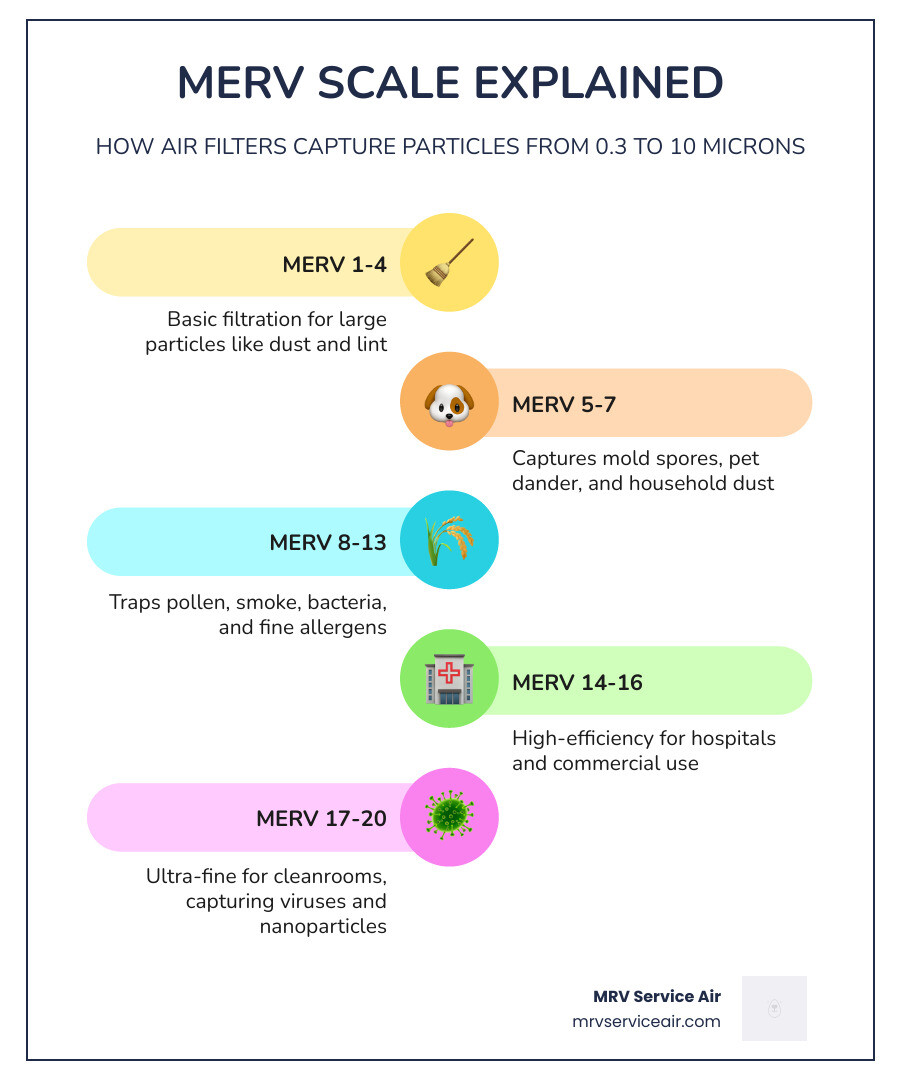
Air filter types and MERV ratings explained simply: MERV stands for Minimum Efficiency Reporting Value, a standardized scale developed by ASHRAE in 1987 that measures how effectively an air filter captures airborne particles between 0.3 and 10 microns in size. Here is a quick overview:
- MERV 1-4 – Basic filtration; catches large particles like lint and dust mites
- MERV 5-7 – Improved filtration; captures mold spores and pet dander
- MERV 8-10 – Good residential performance; traps pollen, dust, and some smoke
- MERV 11-13 – Enhanced filtration; captures fine particles, bacteria, and virus carriers
- MERV 14-16 – High-efficiency; used in hospitals and commercial settings
- MERV 17-20 – Ultra-fine filtration; reserved for cleanrooms and surgical environments
Filter types at a glance:
| Filter Type | Typical MERV Range | Best For |
|---|---|---|
| Fiberglass flat-panel | 1-4 | Basic equipment protection |
| Pleated synthetic | 8-13 | Most residential homes |
| Electrostatic | 8-12 | Allergy-prone households |
| HEPA | Beyond MERV scale | Standalone air purifiers |
For most homes in Central Iowa, a MERV 8 to 13 pleated filter is the right choice — balancing clean indoor air with the airflow your HVAC system needs to run efficiently.
Most homeowners never think twice about the flat panel they slide into their furnace every few months. But that one small choice — which filter you use and what its rating means — has a surprisingly large impact on the air your family breathes every single day. In April 2026, with wildfire smoke, pollen seasons, and post-pandemic awareness of indoor air quality all driving greater attention to what floats through our vents, understanding the MERV scale has never been more relevant.
The tricky part is that a higher number is not always better. Use too dense a filter in the wrong system, and you can actually strain your HVAC equipment, raise your energy bills, and shorten the life of your unit. Use too low a rating, and you are letting allergens, pet dander, and fine particles circulate freely through your home.
This guide breaks it all down — no jargon, no confusion — so you can make a confident, informed decision for your specific home and system.
What is MERV? Air Filter Types and MERV Ratings Explained
When we talk about the “Minimum Efficiency Reporting Value,” we are referencing a universal industry standard. Developed by the American Society of Heating, Refrigerating and Air-Conditioning Engineers (ASHRAE) back in 1987, MERV was designed to give us a way to compare apples to apples. Before this, it was hard to tell if one “high-efficiency” filter was actually better than another.
Think of the MERV rating as a report card for your filter. It measures how effectively the filter captures particles ranging from 0.3 to 10 microns. To give you some perspective, a single human hair is roughly 70 microns wide. We are talking about particles so small they are often invisible to the naked eye, yet they can have a massive impact on your health.
However, there is a catch. As a filter gets better at catching tiny particles, it usually becomes more “restrictive.” This means it takes more effort for your furnace or air conditioner to pull air through the material. If you choose a rating that is too high for your specific equipment, you create “airflow resistance” or static pressure. This is why our HVAC contractor services in Ankeny often include checking your system’s compatibility before you make a major jump in filter quality.
Understanding the MERV Scale and Particle Sizes
The MERV scale isn’t just a random list of numbers; it’s based on the percentage of particles trapped in three specific size ranges. As we move up the scale, the filter becomes significantly more “tight-knit.”
| MERV Rating | 0.3–1.0 Microns (Small) | 1.0–3.0 Microns (Medium) | 3.0–10.0 Microns (Large) |
|---|---|---|---|
| MERV 1–4 | Not Rated | Not Rated | < 20% |
| MERV 8 | Not Rated | ≥ 20% | ≥ 70% |
| MERV 11 | ≥ 20% | ≥ 65% | ≥ 85% |
| MERV 13 | ≥ 50% | ≥ 85% | ≥ 90% |
| MERV 16 | ≥ 95% | ≥ 95% | ≥ 95% |
As you can see, a standard MERV 8 filter is great for catching large stuff like dust mites and pollen. But if you want to stop smoke, bacteria, or the tiny droplets that carry viruses, you need to look toward the MERV 11 to 13 range. This is particularly important for ventilation system maintenance, as clean ducts won’t stay clean for long if your filter is letting fine dust through.
How Air Filter Types and MERV Ratings Explained Impact Indoor Air Quality
Your respiratory health is directly tied to what is floating in your home’s air. The EPA notes that indoor air can actually be more polluted than outdoor air because particles get trapped and recirculated. For families dealing with asthma or severe allergies, upgrading to a MERV 13 filter can be a game-changer.
A MERV 13 filter is often considered the “sweet spot” for high-level residential air quality. It captures at least 50% of the tiniest particles (0.3–1.0 microns) and over 90% of larger allergens. When we provide indoor air quality services, we often look at how these filters can reduce the “aerosol” load in the home, which includes everything from sneeze droplets to cooking fumes.
Comparing MERV to MPR and FPR Rating Systems
If you’ve ever stood in the aisle of a big-box hardware store, you’ve likely seen other numbers like MPR or FPR. These can be confusing! Here is how they stack up against the industry-standard MERV:
- MPR (Microparticle Performance Rating): This is used by 3M (Filtrete). It focuses on the filter’s ability to catch particles smaller than 1 micron. A MERV 11 is roughly equivalent to an MPR 1000-1200.
- FPR (Filter Performance Rating): This is Home Depot’s brand-specific scale, ranging from 4 to 10. A MERV 13 is usually equivalent to an FPR 10.
While these systems are helpful for their specific brands, we always recommend looking for the MERV rating first. It is the most scientifically rigorous way to ensure your system is maintaining high energy efficiency services while cleaning the air.
Comparing Common Air Filter Materials and Designs
The material your filter is made of determines its MERV potential. Not all filters are created equal!
- Fiberglass Flat-Panels: These are the “see-through” blue or green filters you often find for a few dollars. They usually have a MERV rating of 1 to 4. Their main job isn’t to clean your air—it’s to keep large “chunks” of dust from clogging your furnace motor. They offer almost zero protection against allergens.
- Pleated Synthetic Media: This is the gold standard for modern homes. By folding the material into pleats, manufacturers create a much larger surface area. More surface area means the filter can trap more dust without immediately choking off your airflow. In fact, pleated filters can provide up to 20 times better filtration than fiberglass.
- Electrostatic Filters: These use self-charging fibers to attract particles like a magnet. They are excellent for pet dander and can be found in both disposable and washable versions (though we usually recommend disposable for better hygiene).
- HEPA Filters: High-Efficiency Particulate Air filters are in a league of their own. They must trap 99.97% of particles down to 0.3 microns. While they are amazing for air quality, most residential central HVAC services cannot handle a HEPA filter because they are too thick and restrictive for a standard blower motor.
Selecting the Best MERV Rating for Your Home Environment
So, which one do you actually need? We usually break it down by the “residents” of the home:
- The “Standard” Home (No Pets, No Allergies): A MERV 8 pleated filter is your baseline. It keeps the equipment clean and catches the most common household dust.
- The Pet Owner Home: If you have dogs or cats, you have dander and fur. A MERV 11 upgrade is highly recommended to keep those allergens from settling into your carpets and lungs.
- The Allergy or Asthma Household: To truly find relief, a MERV 13 is the way to go. It is efficient enough to catch mold spores and fine allergens that trigger respiratory issues. This is a common recommendation when we perform furnace services in West Des Moines for families concerned about seasonal health.
- The Smoker’s Home: Smoke particles are incredibly tiny. You’ll want at least a MERV 13, and potentially a filter with an added carbon layer to help neutralize odors.
Choosing Between Air Filter Types and MERV Ratings Explained for Your HVAC System
Before you run out and buy the highest-rated filter you can find, we have to talk about “static pressure.” Your HVAC system has a fan motor designed to push air through a certain amount of resistance.
Older furnaces (15–20 years old) often use PSC motors, which are less powerful. If you put a heavy MERV 13 filter in one of these, it can cause the system to overheat or the “limit switch” to trip, shutting the unit down. Newer systems often have ECM (variable speed) motors that can adjust to higher resistance, but even they have limits. If you are unsure about your heating systems in Waukee, it is always best to have a professional check the pressure levels.
Maintenance, Thickness, and System Compatibility
One of the best ways to get high MERV performance without killing your airflow is to go thicker.
- 1-inch Filters: These are the most common but have the least surface area. They need to be changed often — usually every 30 to 90 days.
- 4-inch to 5-inch Media Filters: These require a special cabinet installed in your duct work services in Johnston. Because they have so much more material, they can have a high MERV rating (like 11 or 13) while still allowing air to flow freely. Plus, they often last 6 to 12 months!
Pro Tip: Always check the “nominal” vs. “actual” size. A filter labeled 20x25x1 is the nominal size, but the actual physical measurement is usually about a half-inch smaller. Also, look for the arrow on the frame! It should always point toward the furnace blower, not away from it.
Frequently Asked Questions and Conclusion
Can my residential HVAC system handle a MERV 13 filter?
Most modern systems can, but it depends on the “static pressure” of your ductwork. If your ducts are undersized or your furnace is very old, a MERV 13 might restrict airflow too much. We recommend having an HVAC professional test your system’s airflow before making a permanent switch to MERV 13.
What is the main difference between MERV and HEPA filters?
MERV is a scale (1–20) used for standard HVAC filters. HEPA is a specific government standard for ultra-high filtration (99.97%). Most home HVAC systems aren’t strong enough to push air through a HEPA filter, so HEPA is usually reserved for standalone air purifiers or specialized hospital systems.
How often should I change a high-MERV pleated filter?
For a 1-inch MERV 11 or 13 filter, you should check it every 30 days. If you have pets or live in a dusty area, it will likely need a change every 2 months. If the filter looks gray or “fuzzy,” it’s time for a new one!
At All Seasons HVAC LLC, we are proud to serve the Des Moines community with prompt, quality service at affordable prices. We know that choosing the right filter is the first step toward a healthier home. If you are ready to take the next step in protecting your family’s health, we are here to help.
Schedule your indoor air quality service in Des Moines today and let our experts ensure your home is a breath of fresh air!