







How Much Does a High SEER AC Save in the Central Valley — And Is It Worth It?
How much does a high SEER AC save in the Central Valley is one of the most important questions you can ask before replacing your cooling system. The short answer: quite a lot — especially here, where summers run long, brutal, and expensive.
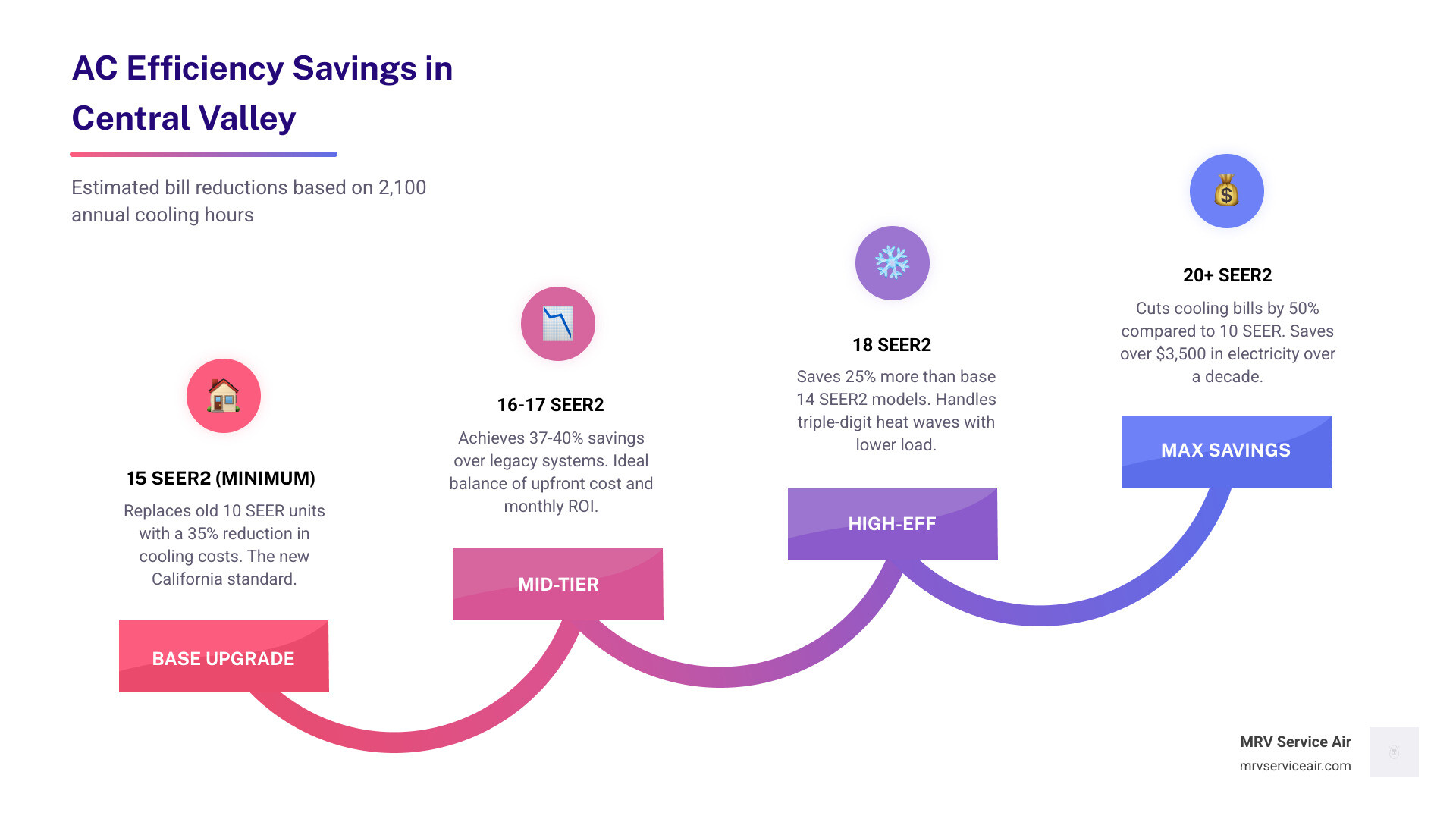
Here’s a quick look at estimated annual savings by efficiency level for a typical 3-ton system running 2,100 cooling hours per year:
| Upgrade Scenario | Estimated Annual Savings |
|---|---|
| 10 SEER → 15 SEER2 | ~35% reduction in cooling costs |
| 10 SEER → 16 SEER2 | ~37–40% reduction in cooling costs |
| 10 SEER → 20 SEER2 | ~50% reduction in cooling costs |
| 14 SEER2 → 18 SEER2 | ~20–25% reduction in cooling costs |
| 14 SEER2 → 20 SEER2 | ~43% reduction in cooling costs |
For a household spending $1,200 a year on cooling, upgrading to a 16 SEER system could bring that bill down to around $850 — saving roughly $350 every year, and over $3,500 across a decade.
In a place like Delano or Bakersfield, where your AC can run for six months straight and temperatures regularly push past 100°F, even a modest efficiency bump pays off fast. The Central Valley’s long cooling season is exactly what makes a high-SEER upgrade a smarter investment here than almost anywhere else in the country.
This guide breaks down the real numbers — by efficiency tier, home size, usage pattern, and local electricity rates — so you can make a confident decision about your next AC system.
Understanding SEER2 and California Efficiency Standards
If you have been looking at new air conditioners lately, you’ve likely seen two different acronyms: SEER and SEER2. SEER stands for Seasonal Energy Efficiency Ratio. Think of it like the “miles per gallon” for your air conditioner. The higher the number, the less electricity the unit uses to keep your home cool.
As of May 2026, the industry has fully transitioned to SEER2. This is a newer, more rigorous testing standard introduced by the Department of Energy (DOE) to better reflect real-world conditions. Specifically, SEER2 testing uses higher external static pressure (the resistance the air feels as it moves through your ducts). Because the test is harder to pass, a SEER2 rating usually looks about 4.5% lower than an old SEER rating, even if the unit is just as efficient.
In California and the Southwest region, regulations are strict. For any new split-system air conditioner installed in Delano or Bakersfield, the federal minimum is now 15 SEER or 14.3 SEER2. If you are looking for an even more efficient option, you’ll want to check for Energy Star certification, which often requires units to exceed these minimums significantly.
Understanding these ratings is vital because of The Science of Sweat: What Happens to Your AC When It’s 110 Degrees. In our local climate, an under-performing or inefficient unit doesn’t just cost more; it struggles to maintain comfort when the valley heat becomes extreme.
How Much Does a High SEER AC Save in the Central Valley?
When we talk about how much does a high seer ac save in the central valley, we have to look at our unique geography. Most national averages assume about 1,000 to 1,200 cooling hours per year. In the Central Valley, we often hit 2,100 hours or more. Because we run our systems twice as much as the average American, our savings are effectively doubled.
The “7% Rule” is a great way to estimate your gains: for every 1-point increase in SEER rating, you generally see a 7% improvement in energy efficiency.
Comparison of Annual Energy Consumption
| System Efficiency | Estimated Annual kWh Usage (3-Ton) | Estimated Annual Cost (at $0.30/kWh) |
|---|---|---|
| 10 SEER (Old Unit) | 6,300 kWh | $1,890 |
| 14.3 SEER2 (Minimum) | 4,400 kWh | $1,320 |
| 18 SEER2 (High Efficiency) | 3,500 kWh | $1,050 |
| 20 SEER2 (Premium) | 3,150 kWh | $945 |
By moving from an old 10 SEER unit to a modern 20 SEER2 system, many homeowners in Kern and Tulare counties can achieve a 50% reduction in cooling costs. You can learn more about these financial impacts in our guide on How to Save Thousands on California HVAC Upgrades.
How much does a high seer ac save in the central valley during peak summer months?
During July and August, the Central Valley experiences triple-digit heat waves that can last for weeks. This is when a high-SEER unit truly earns its keep. Modern high-efficiency systems often feature variable-speed compressors. Unlike older units that are either “100% on” or “off,” a variable-speed system can scale its power down to 25% or 50% capacity.
This prevents the constant, power-hungry “kick-on” cycles that happen when a standard AC tries to maintain a steady temperature. During these peak months, the load reduction provided by a variable-speed unit can keep your monthly utility bill from skyrocketing. Furthermore, many residents are finding that The Ultimate Guide to Heat Pump Benefits for Central Valley Residents offers an even more efficient way to handle both summer cooling and winter heating using high-SEER technology.
How much does a high seer ac save in the central valley over its 15-year lifespan?
If you save $350 to $500 a year, that adds up to $5,250 to $7,500 over a 15-year lifespan. But the savings go beyond just the electric bill. High-efficiency units are built with more advanced components that often lead to a reduced frequency of repairs.
Additionally, a high-SEER system is a major selling point for a home. In 2026, home buyers in Bakersfield and Shafter are highly conscious of energy costs. A modern, efficient HVAC system can increase your home’s resale value and marketability. As we discuss in The Cold Hard Truth: Why HVAC Replacement Is a Smart Investment, the ROI of a new system is found in both daily comfort and long-term equity.
Factors That Influence Real-World Efficiency
A high SEER rating on the box is a great start, but it isn’t a guarantee of savings if the rest of your home isn’t ready. Several factors can “rob” your AC of its efficiency:
- Manual J Load Calculations: We never guess on size. A system that is too large will “short-cycle,” turning on and off too quickly to dehumidify the air. A system that is too small will run forever and never cool the home. Both scenarios destroy your SEER savings.
- Ductwork Integrity: In the Central Valley, leaky ducts are a massive problem. If your ducts are in a hot attic and have holes, you could be losing 20–30% of your cooled air before it ever reaches your living room.
- The Valley’s Environment: We deal with unique challenges here. Why the Valley’s Dust and Heat Are Your AC’s Worst Enemies explains how dust can coat your coils, forcing a 20 SEER unit to work like a 10 SEER unit.
- Attic Insulation: If your insulation is thin, the heat from the roof radiates into your home, forcing the AC to work overtime regardless of its rating.
- Two-Stage Cooling: Mid-to-high SEER units often use two-stage technology, allowing the system to run on a “low” setting for most of the day and only kicking into “high” when the afternoon sun is at its peak.
Maximizing Your ROI with Rebates and Incentives
To offset the upfront cost of a high-efficiency system, there are several programs available as of May 2026. Because these programs change frequently, we recommend checking with us for the latest updates in Delano and surrounding areas.
- Federal Tax Credits: Under the Energy Efficient Home Improvement Credit, homeowners can often claim a significant percentage of the cost of high-efficiency AC units or heat pumps (up to a certain annual limit).
- Utility Rebates: Local providers like PG&E or Southern California Edison frequently offer rebates for customers who install Energy Star-certified equipment.
- Local Incentive Programs: Some Kern and Tulare county programs focus on “decarbonization,” providing extra incentives for switching to high-efficiency electric heat pumps.
Documentation Needed for HVAC Tax Credits:
- Manufacturer’s Certification Statement
- Detailed receipt showing the model and serial numbers
- The AHRI (Air-Conditioning, Heating, and Refrigeration Institute) certificate for the matched system
Best Practices for Choosing and Sizing Your System
Choosing the right system is about finding the “sweet spot.” For many Central Valley homes, a SEER2 rating between 16 and 18 offers the best balance of upfront cost and long-term payback. While a 22+ SEER unit is incredibly efficient, the time it takes to “break even” might be longer than you plan to stay in the home.
Professional Installation is Non-Negotiable An improperly installed high-efficiency unit can lose up to 30% of its rated efficiency on day one. It is crucial to:
- Match Indoor and Outdoor Coils: If you keep an old indoor coil and only replace the outdoor unit, you will never achieve the rated SEER2 efficiency. They must be a “matched set.”
- Verify Airflow: High-efficiency systems require specific airflow volumes to function correctly.
- Schedule Maintenance: Regular tune-ups keep the coils clean and the refrigerant levels precise, preserving your savings for years to come.
Frequently Asked Questions about Central Valley AC Savings
What is the difference between SEER and SEER2?
SEER2 is the new testing standard that began in 2023. It uses a higher static pressure during testing to more accurately simulate how an AC performs when connected to actual ductwork. Generally, a SEER2 rating is about 4.5% lower numerically than the old SEER rating for the same piece of equipment.
Is a 20 SEER2 unit worth the investment in the Central Valley?
For most homeowners, yes—especially if you plan to stay in your home for 7+ years. Because our cooling season is so long and our electricity rates are relatively high, the “payback period” for a premium unit is much shorter in Bakersfield or Delano than it would be in a cooler climate.
How do I find the SEER rating on my current air conditioner?
Look for the yellow “EnergyGuide” sticker on the side of your outdoor condenser unit. If that is missing or faded, you can find the model and serial number on the manufacturer’s data plate. You can then look up those numbers online or call us, and we can identify the efficiency rating for you.
Conclusion
Investing in a high-efficiency system is one of the most effective ways to lower your cost of living in the Central Valley. When you consider how much does a high seer ac save in the central valley, the numbers clearly show that the long-term energy savings, combined with improved comfort and increased home value, far outweigh the initial investment.
At MRV Service Air, we are proud to provide prompt, quality service at affordable prices. Whether you are in Delano, Bakersfield, Wasco, or Porterville, our team is here to help you navigate SEER2 ratings and find the perfect cooling solution for your home.
Start saving today with professional AC service in Bakersfield and Delano and let us help you keep your cool all summer long.