







Why Understanding How HVAC Load Calculations Work for Hot Climates Can Save You From a Sweltering Summer
How HVAC load calculations work for hot climates comes down to one core idea: your HVAC system must be sized precisely for the specific heat, humidity, and solar conditions of your location — not just your square footage.
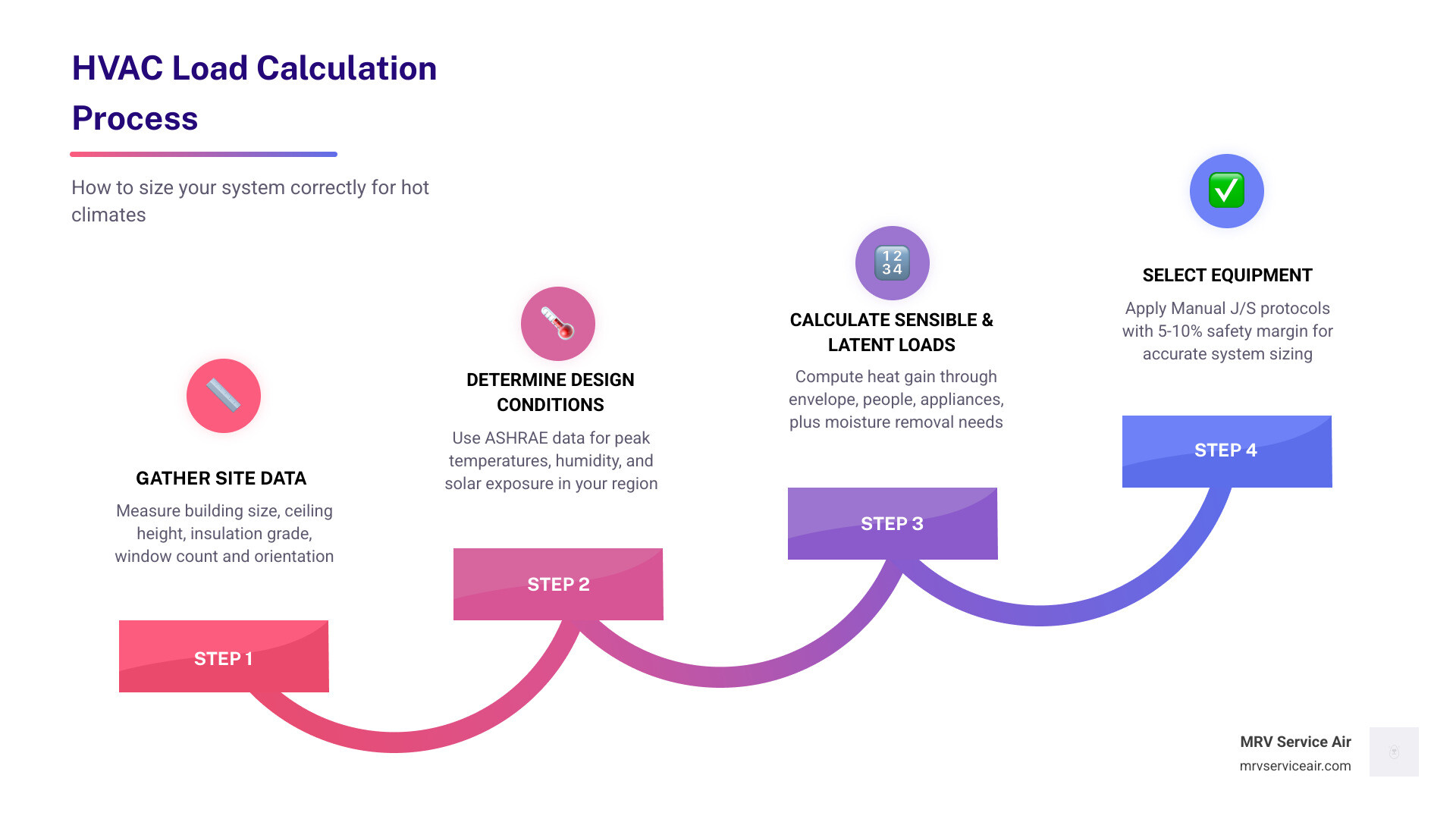
Here is a quick breakdown of the process:
- Gather site data — location, building size, ceiling height, insulation grade, window count and orientation
- Determine outdoor design conditions — use ASHRAE climate data for your region’s peak temperatures and humidity levels
- Calculate sensible heat load — heat entering through walls, roof, windows, and from people and equipment
- Calculate latent heat load — moisture added by outdoor air, occupants, and infiltration
- Add internal and ventilation loads — occupants, appliances, electronics, and fresh air requirements
- Account for building envelope factors — insulation R-values, glazing, shading, and duct losses
- Apply a safety margin — typically 5–10% above the calculated total load
- Select properly sized equipment — using Manual J and Manual S protocols to match real performance data
If you live or run a business in a hot climate like Kern County’s Central Valley, where summer temperatures can push well past 100°F, getting this process right is not optional — it is the difference between a system that keeps up and one that fails you on the hottest day of the year.
Most homeowners and small business owners never see a load calculation. Their contractor installs whatever size “seems right” based on square footage, and the result is a system that either short-cycles and leaves the air muggy, or runs nonstop and still can’t keep up. Both outcomes cost you money, comfort, and equipment lifespan.
The good news is that a proper HVAC load calculation — done with real data and the right methodology — removes all the guesswork. This guide walks you through exactly how it works, what factors matter most in hot climates, and why it matters so much when the temperature outside is unforgiving.
How HVAC Load Calculations Work for Hot Climates: The Core Mechanics

At the most basic level, a load calculation answers one question: how many BTUs per hour must we remove from a building to keep it comfortable at design conditions?
In cooling, 1 ton of capacity equals 12,000 BTU per hour. But choosing tonnage is the end of the process, not the beginning. First, we have to understand where the heat is coming from and when it shows up.
In hot climates like Delano, Bakersfield, Wasco, Shafter, and nearby Central Valley communities, cooling loads are driven by:
- High outdoor dry-bulb temperatures
- Strong solar gain through roofs and windows
- Heat conducted through walls, ceilings, and attic assemblies
- Air leakage and ventilation
- Internal gains from people, lighting, appliances, and electronics
- Duct losses, especially when ducts run through very hot attics
- Thermal storage, where building materials absorb heat and release it later
That last point matters more than many people realize. Heat gain and cooling load are related, but they are not always identical at the same moment. Some heat gets stored in building mass and shows up later, which is one reason modern methods are better than simple rules of thumb.
If you have ever wondered why an AC can seem fine at noon but struggle at 5 p.m., thermal storage and solar loading are usually part of the answer. Our article on what happens to your AC when it’s 110 degrees explores that real-world stress in more detail.
Understanding Sensible vs. Latent Heat Loads
Cooling load is usually split into two buckets:
- Sensible load
- Latent load
Sensible load is the heat that raises air temperature. If the room is too hot, that is sensible heat at work. In hot-dry parts of the Central Valley, sensible load usually dominates because outdoor temperatures are extreme and solar gain is intense.
Latent load is the moisture load. It is the energy required to remove water vapor from the air. In warm-humid climates, latent load can become a large share of the total cooling load. Research commonly places latent load in humid regions around 20% to 40% of the total, and sometimes more in especially damp conditions.
That difference is one of the key ways hot climates vary:
- Hot-dry climates: higher sensible load, lower latent load, larger day-to-night temperature swing
- Warm-humid climates: lower dry-bulb extremes than deserts, but higher latent load and smaller daily temperature swing
For most of our service area, sensible heat is the heavyweight champion. But latent load still matters because infiltration, ventilation air, occupancy, kitchens, bathrooms, and duct leakage can all add moisture or reduce effective comfort. If the unit handles temperature but not moisture well, the home can still feel sticky and uncomfortable.
And yes, dust matters too. Dirty filters, clogged coils, and valley debris reduce real cooling performance even when the math on paper looks correct. For more on that, see Why the Valley’s Dust and Heat Are Your AC’s Worst Enemies.
The Role of Manual J and Manual S Standards
For residential systems, ACCA Manual J is the standard method used to calculate the building load. It looks at the whole house and, ideally, each room individually.
Manual J includes inputs such as:
- House location
- Floor area
- Ceiling height
- Insulation levels
- Window area and orientation
- Window type and solar characteristics
- Air leakage assumptions
- Number of occupants
- Internal heat from lighting and equipment
- Duct location and duct losses
- Ventilation requirements
Once the load is calculated, Manual S is used to select the actual equipment. That matters because a system’s real performance depends on actual conditions, not just its nameplate size. A 3-ton system on paper is not automatically the right 3-ton system for a specific house in Delano at peak summer conditions.
Manual J tells us the load. Manual S tells us which equipment can actually satisfy it.
That pairing is what separates professional sizing from “it looks like a four-ton house.” That phrase may sound confident, but it is not science.
The Impact of Extreme Heat and Humidity on System Sizing
Hot climates are not all the same. The load profile of a dry inland valley home is different from that of a muggy coastal home, even if both need cooling.
Here is a simple comparison:
| Factor | Hot-Dry Conditions | Warm-Humid Conditions |
|---|---|---|
| Main challenge | High temperature and overheating | Heat plus high moisture |
| Sensible load | Very high | High |
| Latent load | Lower | Much higher |
| Diurnal temperature swing | Usually large | Usually small |
| Solar gain impact | Extremely important | Very important |
| Ventilation penalty | Mostly temperature-driven | Temperature and humidity-driven |
For Central Valley homes, the design challenge is often brutal afternoon sensible load from sun and high outdoor temperatures. That is why a house may need strong envelope protection, accurate sizing, and good duct design even when humidity is not the main villain.
This is also why we often talk about building a stronger cooling strategy for our area. Why Your Central Valley Home Needs a Heavy Duty HVAC Strategy explains why ordinary assumptions often fall short here.
Climate Analysis and Weather Data Integration
Good load calculations start with climate data, not guesses.
Industry-standard weather data, including ASHRAE design data, helps define the outdoor conditions a system should be designed around. Instead of sizing for the single hottest temperature ever recorded, designers typically use percentile-based design conditions.
For cooling, common ASHRAE values include 0.4%, 1.0%, 2.0%, and 5.0% annual exceedance values. These correspond to conditions exceeded on average by about:
- 35 hours per year at 0.4%
- 88 hours per year at 1.0%
- 175 hours per year at 2.0%
- 438 hours per year at 5.0%
This matters because equipment should be sized for realistic peak design conditions, not freak one-day extremes and not mild averages either.
Climate analysis also considers:
- Peak dry-bulb temperature
- Mean coincident wet-bulb temperature
- Humidity trends
- Seasonal shifts
- Day-night temperature range
- Solar intensity
In a hot-dry climate, the large daily temperature swing affects when the peak load occurs and how much building mass helps or hurts. In a humid climate, the smaller daily swing means less overnight relief and more persistent latent load.
How HVAC Load Calculations Work for Hot Climates During Heatwaves
Heatwaves are where bad sizing gets exposed fast.
During extreme heat, sensible load rises because the temperature difference between indoors and outdoors increases. If infiltration is present and humidity rises, latent load can also increase. Total heat load goes up, and the system has to remove more heat per hour to hold indoor setpoint.
Many simplified calculators assume standard conditions like 95 degrees outdoors and 72 degrees indoors. Those quick tools can be useful for rough screening, but they are not enough for final equipment selection in Central Valley conditions where temperatures often climb higher.
The goal is not to size for every record-breaking hour with massive oversizing. The goal is to size correctly using accepted design conditions, real building data, and equipment performance data. Oversizing “just to be safe” often creates new problems, especially short cycling and poor humidity removal.
Building Envelope Factors: Why Your Home’s Design Matters in Delano
The building envelope is everything that separates conditioned indoor space from the outdoor environment. In hot climates, it can make or break cooling performance.
Key envelope inputs in load calculations include:
- Wall and ceiling insulation levels
- Roof color and attic conditions
- Window U-factor
- Solar Heat Gain Coefficient, or SHGC
- Window area and orientation
- Overhangs and exterior shading
- Air sealing quality
- Door construction
- Duct location
A well-insulated, well-sealed house with good windows may need dramatically less cooling than an older house of the same size. That is why square footage alone is such a terrible sizing tool.
Solar Heat Gain and Window Orientation
In hot climates, windows are often one of the biggest load drivers.
South- and west-facing glass typically receives more intense sun exposure during the hottest part of the day, especially in late afternoon when outdoor temperatures are already near their peak. That can create a double hit:
- Direct solar gain through glazing
- Radiant heating of interior surfaces
Orientation matters so much that two identical rooms can have very different cooling loads just because one faces west and one faces north.
Load calculations account for:
- Window direction
- Glass area
- SHGC
- Shading from trees, overhangs, screens, or nearby structures
- Interior blinds or coverings, where applicable
Good glazing and shading can reduce cooling demand significantly. Poorly shaded glass can act like a heat invitation. A polite invitation, maybe, but still not one you wanted.
Thermal bridging matters too. Framing members conduct heat more readily than insulation, lowering the effective performance of a wall or roof assembly. This is another reason real construction details matter more than broad assumptions.
Infiltration, Ventilation, and Duct System Loads
Air leakage is sneaky. It is invisible, but it can add a large load.
When hot outside air leaks into the house, your system has to cool it. In more humid conditions, it also has to dehumidify it. Research often shows infiltration can account for a meaningful share of heating and cooling demand, and duct systems in unconditioned spaces may lose 15% to 30% of delivered air.
That is especially relevant in hot attics. If supply ducts or return leaks are outside the conditioned envelope, the effective cooling load increases because the system is fighting attic heat too.
Good load calculations consider:
- Infiltration rates
- Mechanical ventilation requirements
- Duct insulation
- Duct leakage
- Duct location
Blower door testing can improve accuracy by measuring actual leakage rather than relying only on defaults. And if your ducts live in a blazing attic, that should absolutely be part of the conversation. Our Valley Dust vs Your HVAC: A Survival Guide covers another reason valley systems need extra protection and maintenance.
Step-by-Step: How HVAC Load Calculations Work for Hot Climates in Practice
A proper load calculation is part building science, part data collection, and part equipment matching. Here is what the process looks like in practice.
Gathering Site Data: How HVAC Load Calculations Work for Hot Climates
First, we gather the physical facts about the house.
That includes:
- Address and climate location
- Total conditioned floor area
- Room-by-room dimensions
- Ceiling heights
- Construction type
- Insulation grade in walls and attic
- Window count, size, type, and orientation
- Door sizes and locations
- Shading conditions
- Duct location and insulation
- Air leakage assumptions or test data
Modern tools can speed up this process. Some field workflows now use LiDAR-powered 3D scanning to capture building geometry accurately on site. Whether gathered by tape measure, plans, or digital scan, the key is accuracy.
A room-by-room assessment is especially valuable because comfort problems are often local, not whole-house. One back bedroom with west-facing glass may need a very different airflow target than a shaded interior office.
Calculating Sensible and Latent Loads: How HVAC Load Calculations Work for Hot Climates
Once the site data is collected, we calculate the load components.
Sensible loads include heat from:
- Walls
- Roof and ceilings
- Windows and skylights
- Solar radiation
- Occupants
- Lighting
- Appliances
- Electronics
- Duct gains
- Ventilation air
Latent loads include moisture from:
- Occupants
- Outdoor ventilation air
- Infiltration
- Kitchens, baths, and other moisture-producing activities
Typical residential calculations also include internal gains from devices and appliances. That is increasingly important because homes are full of electronics, chargers, televisions, computers, and kitchen equipment.
Then we combine the components into:
- Room sensible load
- Room latent load
- Whole-house sensible load
- Whole-house latent load
- Total cooling load
From there, the designer looks at sensible heat ratio, or SHR, which is the sensible portion of the total load. In dry climates, SHR tends to be higher because temperature reduction dominates. In humid climates, SHR drops because moisture removal becomes a larger share of the job.
The final step is equipment matching using actual performance data at expected operating conditions, not just catalog tonnage.
Optimizing Efficiency and Comfort Through Proper Sizing
The point of load calculations is not just to avoid being too small. It is also to avoid being too big.
Oversized systems often:
- Short-cycle
- Use more energy
- Deliver uneven temperatures
- Remove less moisture per cycle
- Increase wear and tear
- Reduce comfort
Some research shows oversized systems can waste 15% to 30% more energy through short cycling. They may cool the thermostat quickly without running long enough to control humidity or distribute air evenly.
This is especially important when selecting newer equipment such as heat pumps and variable-capacity systems. If you are exploring that route, our Ultimate Guide to Heat Pump Benefits for Central Valley Residents is a good next read.
Avoiding the “Rule of Thumb” Trap
The classic “one ton per 400 to 600 square feet” rule is outdated for many homes. Research on hot-climate houses has shown that these shortcuts can oversize systems dramatically, sometimes by a factor that is far beyond what the home actually needs.
More recent analyses of newer homes often land closer to 1,000 square feet per ton or even more, depending on insulation, airtightness, windows, and design. That does not mean every house should use 1,000 square feet per ton either. It means shortcuts are unreliable.
Why rules of thumb fail:
- They ignore insulation differences
- They ignore window orientation
- They ignore ceiling height
- They ignore duct losses
- They ignore infiltration
- They ignore occupancy and internal gains
- They ignore real local climate data
In other words, they ignore the very things that create the load.
Energy Efficiency Strategies for Hot Regions
Once the load is known, efficiency decisions get much smarter.
In hot regions, good strategies often include:
- Right-sized equipment instead of oversized equipment
- Variable-capacity or staged systems for better part-load performance
- Better attic insulation and radiant barriers where appropriate
- Lower-SHGC windows or exterior shading on hot exposures
- Improved duct sealing and insulation
- Air sealing to reduce infiltration
- Ventilation designed to meet needs without unnecessary load
- Equipment matched with proper airflow and fan settings
A modest safety margin, often around 5% to 10%, can be appropriate. But piling on multiple safety factors usually backfires. Bigger is not better in HVAC. Bigger is often just louder, shorter-cycling, and more dramatic than necessary.
Frequently Asked Questions about HVAC Load Calculations
What is the difference between sensible and latent heat in hot climates?
Sensible heat raises temperature. Latent heat adds moisture. In hot-dry climates like much of the Central Valley, sensible heat usually dominates because the outdoor air is very hot and solar gain is intense. In humid climates, latent heat becomes a larger share of the total because the system must remove both heat and moisture.
Why is a “rule of thumb” dangerous for sizing AC in the Central Valley?
Because Central Valley homes are affected by extreme sun, high attic temperatures, varying insulation quality, duct conditions, air leakage, and window orientation. Square-foot shortcuts ignore all of that. The result is often an oversized system that short-cycles or an undersized one that struggles during peak heat.
How does window orientation specifically affect my cooling load?
Orientation affects how much solar radiation enters the home and when it enters. West-facing windows are often especially hard on cooling systems because they collect strong late-afternoon sun when outdoor temperatures are already high. South-facing windows also add substantial solar gain. North-facing windows usually contribute less cooling load. A proper calculation adjusts for all of this using the size, glass type, and shading of each window.
Conclusion
In hot climates, HVAC sizing is not guesswork and it should never be based on square footage alone. A proper load calculation looks at sensible and latent loads, local design weather, insulation, windows, infiltration, duct losses, and internal heat sources so the equipment can actually match the home.
For homeowners in Delano, Bakersfield, Porterville, Wasco, Shafter, Earlimart, Richgrove, and nearby Central Valley communities, that level of accuracy is what helps your system hold comfort when summer is at its worst.
At MRV Service Air, we believe comfort starts with doing the fundamentals right. If you want help with air conditioning service, system performance, or planning for the next hot season, contact our experts for professional AC service in Bakersfield and Delano.