







What Is a Heat Pump and How Does It Work?
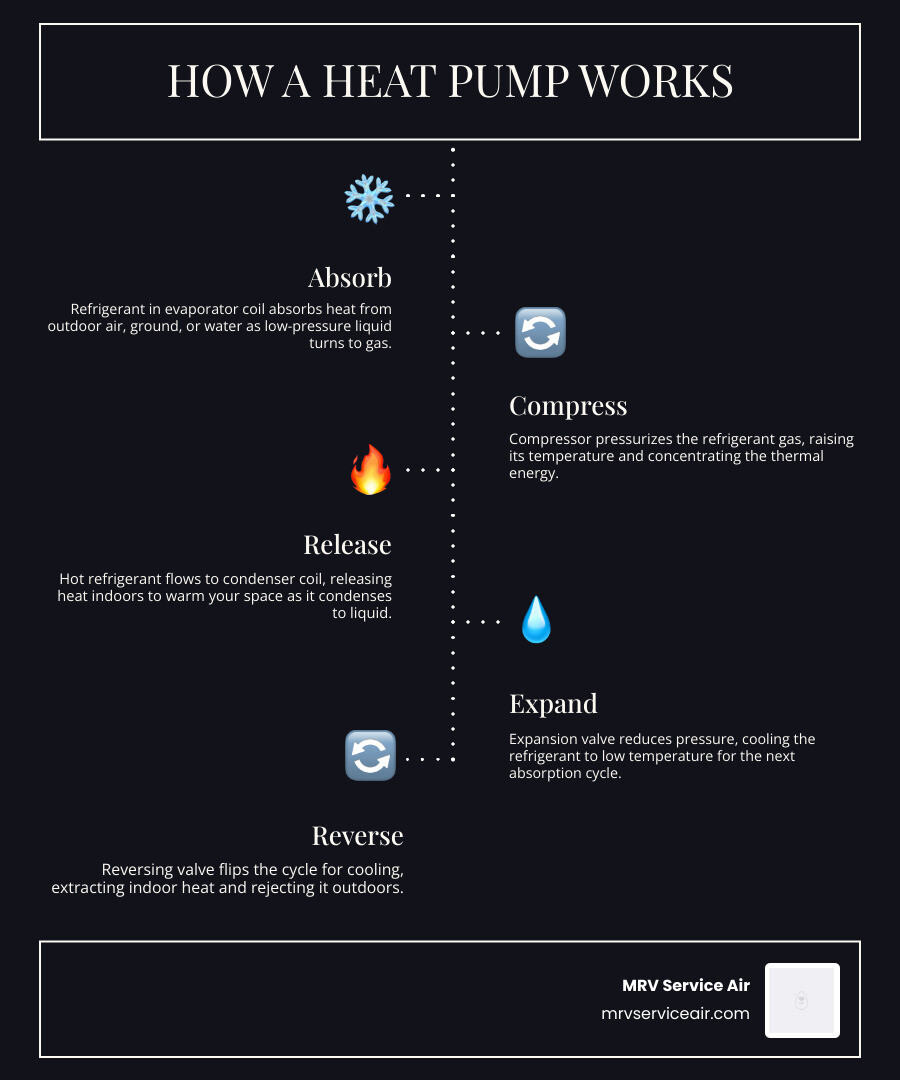
How does a heat pump work? In simple terms, it moves heat from one place to another using a refrigerant loop — rather than burning fuel to create heat. Here’s a quick breakdown:
- Absorb — The refrigerant picks up heat from outdoor air, the ground, or water.
- Compress — A compressor raises the refrigerant’s temperature and pressure.
- Release — That concentrated heat is transferred indoors to warm your space.
- Expand — The refrigerant drops in pressure and temperature, and the cycle repeats.
- Reverse — In summer, the cycle flips to pull heat out of your home, cooling it down.
That one device handles both heating and cooling — all year long, using electricity instead of burning gas or oil.
It almost sounds too good to be true. But the physics are solid: because a heat pump moves existing heat rather than generating it, it can deliver 2 to 4 times more energy than it consumes. A typical household heat pump has a coefficient of performance (COP) around 4 — meaning four units of heating or cooling for every one unit of electricity used. That’s 3 to 5 times more efficient than a gas boiler.
For homeowners in the Central Valley dealing with brutal summer heat and chilly winters, that kind of efficiency isn’t just impressive — it’s practical. Whether you’re trying to cut energy bills, reduce your carbon footprint, or simply keep your home comfortable without worrying about your next utility bill, understanding how a heat pump works is the first step.
In this guide, we’ll walk through every part of the system — from the refrigerant cycle to real-world performance in Kern County’s climate — so you can make a confident, informed decision about your home’s heating and cooling.
Understanding the Basics: How Does a Heat Pump Work?
At its core, a heat pump is a heat-transfer machine. Instead of making heat through combustion like a furnace, it uses electricity to run a compressor and circulate refrigerant through a closed loop. That refrigerant absorbs heat in one place and releases it somewhere else.
That is the simplest answer to how does a heat pump work: it takes heat from a source and moves it to a sink.
- In winter, the source is usually the outdoor air, and the sink is your home.
- In summer, the source is your indoor air, and the sink is the outdoors.
This is why people often say a heat pump is basically an air conditioner that can run in reverse. That is mostly true. A standard AC only cools. A heat pump cools and heats because it has a reversing valve that changes the direction of refrigerant flow.
Even when outdoor air feels cold to us, it still contains thermal energy. As long as the refrigerant inside the system is colder than the outdoor air, heat can move into the refrigerant. That is basic thermodynamics, not magic. It just feels a little magical when your home stays warm on a cold morning.
If you want a more local overview of system performance and setup, our guide on Bakersfield heat pump systems is a helpful next read.
The Four Main Components of the Heat Pump Cycle
A residential heat pump relies on four main parts to move heat efficiently:
- Evaporator
- Compressor
- Condenser
- Expansion valve
These components work together in a repeating refrigeration cycle. The refrigerant changes pressure, temperature, and physical state as it moves through the system.
The Role of the Evaporator and Compressor in how does a heat pump work
The evaporator is where heat gets absorbed. In heating mode, the outdoor coil often acts as the evaporator. Cold, low-pressure refrigerant enters the coil and picks up heat from the outside air. As it absorbs heat, the refrigerant evaporates into a low-pressure vapor.
Next comes the compressor, which is the muscle of the system. It squeezes that vapor, raising both its pressure and temperature. This is a big part of the reason heat pumps work so well: compressing the refrigerant concentrates the heat it already collected and makes it hot enough to release inside your home.
Here is the sequence:
- Refrigerant enters the evaporator cold and at low pressure.
- It absorbs heat from the surrounding air.
- It changes into vapor.
- The compressor pressurizes that vapor.
- Its temperature rises significantly.
This is also why variable-speed compressors are such a big deal in newer systems. They can ramp up or down based on demand, helping maintain comfort and improve efficiency in real-world conditions.
For another local look at system operation and benefits, visit our page on Shafter heat pump systems.
Condensers and Expansion Valves: Completing the Loop
After the compressor heats the refrigerant vapor, it moves to the condenser. In heating mode, the indoor coil acts as the condenser. Here, the refrigerant releases its heat into your indoor air or hydronic system. As it gives up heat, it condenses back into a liquid.
Then the refrigerant passes through the expansion valve. This part reduces the refrigerant’s pressure very quickly. When pressure drops, temperature drops too. That leaves the refrigerant cold enough to return to the evaporator and collect more heat.
So the second half of the cycle looks like this:
- Hot, high-pressure refrigerant enters the condenser.
- Heat transfers into your home.
- Refrigerant condenses into a liquid.
- The expansion valve drops its pressure.
- The refrigerant cools and returns to the evaporator.
This continuous loop is what allows a heat pump to deliver steady comfort without burning fuel. If you are exploring options close to home, our overview of Delano heat pump systems explains more about what to expect from these systems in local conditions.
Heating vs. Cooling: A Year-Round Comfort Solution
One of the biggest advantages of a heat pump is that it can do two jobs with one system. In winter, it brings heat in. In summer, it sends heat out. The key component that makes this possible is the reversing valve.
When the reversing valve changes direction, the indoor and outdoor coils switch roles:
- In heating mode, the outdoor coil absorbs heat and the indoor coil releases it.
- In cooling mode, the indoor coil absorbs heat and the outdoor coil releases it.
That means a heat pump does not create cold air in summer. It removes heat from indoor air, just like a traditional air conditioner. During cooling, it also helps with dehumidification, which matters a lot during hot Central Valley weather.
Reversing the Cycle: how does a heat pump work in Winter
In winter, a heat pump extracts heat from outdoor air and transfers it indoors. Yes, even if the air feels very cold.
Why? Because heat energy exists at any temperature above absolute zero. Outdoor air at 35 degrees F, 20 degrees F, or even below that still contains usable thermal energy. The refrigerant is formulated to evaporate at very low temperatures, so it can absorb that ambient heat.
A basic winter cycle looks like this:
- Outdoor coil absorbs heat from the air.
- Refrigerant evaporates into a vapor.
- Compressor raises pressure and temperature.
- Indoor coil releases heat into your home.
- Refrigerant expands and cools before repeating the cycle.
In colder conditions, many systems also run a defrost cycle. Frost can build on the outdoor coil during heating mode, especially on damp winter days. The unit temporarily reverses operation to melt that frost and protect efficiency. That is normal, even if it catches homeowners off guard the first time.
Standard heat pumps tend to lose efficiency as outdoor temperatures drop, often somewhere in the 25 to 40 degree F range depending on the model. But modern cold-climate systems can keep working at much lower temperatures, with some designed to operate well below 0 degrees F. In our Delano, Wasco, Shafter, Bakersfield, Richgrove, and Earlimart service areas, many homes can benefit from heat pump performance without dealing with the kind of prolonged sub-zero weather seen elsewhere.
For more on local comfort benefits, see why Earlimart homes are turning to heat pumps.
Efficient Cooling Performance in the Central Valley Summer
Summer is where many Central Valley homeowners first appreciate what a heat pump can do. In cooling mode, it works almost exactly like an air conditioner.
Here is the cooling cycle:
- The indoor coil absorbs heat from indoor air.
- Refrigerant evaporates and carries that heat outside.
- The compressor raises pressure and temperature.
- The outdoor coil releases the heat outside.
- The refrigerant expands and cools before returning indoors.
This process helps maintain consistent airflow, remove indoor heat, and reduce indoor humidity. In a place where summer temperatures can be intense, that combination matters.
High-efficiency models can offer strong seasonal cooling performance while also giving you winter heating in the same piece of equipment. If you want a broader look at regional advantages, read The Ultimate Guide to Heat Pump Benefits for Central Valley Residents.
Why Efficiency Matters: COP and Energy Savings
The biggest reason heat pumps get so much attention is efficiency.
A furnace or electric resistance heater creates heat directly. A heat pump transfers heat instead. Because moving heat usually takes less energy than making it from scratch, heat pumps can deliver much more heat than the electricity they consume.
The main efficiency metric is COP, or coefficient of performance. COP is the ratio of heat delivered to electricity used.
- A COP of 1 means 1 unit of electricity gives you 1 unit of heat.
- A COP of 3 means 1 unit of electricity moves 3 units of heat.
- A typical household heat pump often operates around a COP of 4 under favorable conditions.
That is why heat pumps can be described as 200% to 400% efficient in practical terms. It does not violate physics. The system is not creating extra energy; it is transferring available heat from the air, ground, or water.
| System type | Typical heating approach | Approximate efficiency concept |
|---|---|---|
| Heat pump | Moves heat | Often 2 to 4.5 units of heat per 1 unit of electricity |
| Electric baseboard heater | Creates heat through resistance | About 1 unit of heat per 1 unit of electricity |
| Gas furnace | Burns fuel to create heat | Lower overall efficiency than modern heat pumps in many cases |
Some research estimates that current heat pump models are 3 to 5 times more energy efficient than gas boilers, and that they can satisfy more than 80% of global space and water heating needs with a lower carbon footprint than gas-fired condensing boilers. That matters because buildings account for roughly 40% of global emissions, much of it tied to heating.
For homeowners, the takeaway is simple:
- Lower energy use
- Reduced carbon impact
- One system for heating and cooling
- Better use of electricity, especially as grids get cleaner over time
Choosing the Right System for Your Property
Not every heat pump setup looks the same. The right choice depends on your home, your existing equipment, your insulation, your ductwork, and how you use your space.
The most common options include:
- Air-source heat pumps
- Ground-source heat pumps
- Hybrid or dual-fuel systems
- Ductless mini-split heat pumps
Air-source heat pumps
These are the most common residential systems. They pull heat from outdoor air and either deliver it through ducts or through wall-mounted indoor units. For many homes in Delano and surrounding communities, this is the most practical option.
Ground-source heat pumps
Also called geothermal systems, these pull heat from the ground, where temperatures are more stable than outdoor air. They are usually very efficient, but installation is more site-dependent because they require ground loops.
Hybrid systems
A hybrid system pairs a heat pump with a furnace. The heat pump handles milder conditions, and the furnace takes over when temperatures fall to a point where that makes more sense for the home. This can be a useful option for some properties with existing equipment.
Ductless mini-splits
Mini-splits are heat pumps that do not rely on traditional ductwork. They are great for additions, converted garages, older homes, or rooms with uneven comfort.
When planning installation, homeowners should think about:
- Proper system sizing
- Existing ductwork condition
- Insulation and air sealing
- Thermostat compatibility
- Outdoor unit placement
- Noise expectations
- Maintenance access
- Whether backup heat is needed
A poorly sized system can struggle with comfort and efficiency. Too small, and it runs constantly. Too large, and it short cycles. Neither is ideal. This is one reason professional design and installation matter so much.
For more local guidance, take a look at Wasco heat pump services and our tips on finding a heat pump contractor in Richgrove.
Frequently Asked Questions about Heat Pump Operation
Can a heat pump really extract heat from freezing outdoor air?
Yes. Freezing air still contains heat energy. A heat pump uses refrigerant that is colder than the outdoor air, so heat naturally flows into the refrigerant. The compressor then raises that heat to a usable temperature for your home.
The colder it gets outside, the harder the system has to work and the lower the efficiency may become. But that is different from saying it does not work. Modern systems can still provide heat in very cold weather, especially when properly selected for the local climate.
What is the difference between a heat pump and a standard air conditioner?
A standard air conditioner only cools. A heat pump cools and heats.
Both use the same basic refrigeration cycle with an evaporator, compressor, condenser, and expansion valve. The difference is the reversing valve, which lets the heat pump switch direction so it can move heat indoors in winter and outdoors in summer.
So if you have ever wondered whether a heat pump is just an AC with extra talent, the answer is basically yes.
How long does a typical heat pump system last in the Central Valley?
A well-maintained heat pump commonly lasts around 10 to 25 years, depending on system type, usage patterns, installation quality, and maintenance. In the Central Valley, long cooling seasons can add wear because the system often works hard in summer, so regular service is important.
To help extend system life, we recommend:
- Replacing filters regularly
- Keeping the outdoor unit clear of debris
- Scheduling professional maintenance
- Addressing airflow problems early
- Watching for unusual noises or short cycling
Conclusion
Heat pumps are one of the smartest ways to handle year-round home comfort because they do not rely on burning fuel to make heat. Instead, they transfer heat using refrigerant, pressure changes, and a carefully controlled cycle of evaporation and condensation. That is the real answer to how does a heat pump work.
For homeowners across Delano and the surrounding Central Valley communities, that means one system can cool your home in summer, warm it in winter, and do it with impressive efficiency.
At MRV Service Air, we help homeowners understand their options, choose the right equipment, and get dependable performance from properly installed heating and cooling systems. If you are considering a heat pump for your home, schedule your expert consultation with the team at MRV Service Air today.