







Is Central AC or a Ductless Mini Split Right for Your Home?
The central ac vs ductless mini split comparison comes down to one core question most homeowners face when upgrading their comfort system: does your home already have working ductwork, and how well is it performing?
Here’s a quick side-by-side breakdown to help you decide:
| Factor | Central AC | Ductless Mini Split |
|---|---|---|
| Requires ductwork | Yes | No |
| Best for home size | 2,500+ sq ft | Up to 2,000 sq ft |
| Energy efficiency | 13-18 SEER2 (standard) | 16-24+ SEER2 |
| Zoning control | Limited (add-ons needed) | Built-in, per room |
| Installation | Invasive, longer timeline | Minimal (3-inch wall hole) |
| Heating capability | Cooling only (needs furnace) | Heat pump (heats and cools) |
| Noise level | Moderate (vent whoosh) | Very quiet (19-26 dB) |
| Air filtration | Superior (whole-home filters) | Basic (requires frequent cleaning) |
| Federal tax credits | Limited | Up to $2,000 (qualifying heat pumps) |
| Lifespan | 15-20 years | 15-20 years (premium: up to 25) |
Both systems use refrigerant lines to move heat out of your home. But they deliver that conditioned air in very different ways. Central AC pushes air through a network of ducts — and research from the U.S. Department of Energy shows those ducts can lose 20-30% of cooled air before it ever reaches a room. Mini splits skip the ducts entirely, delivering air directly from wall-mounted indoor units.
For homeowners in the Delano area dealing with extreme summer heat, that efficiency gap matters. Whether you’re cooling a large family home or a single room addition, the right system depends on your home’s layout, your budget, and how you use your space.
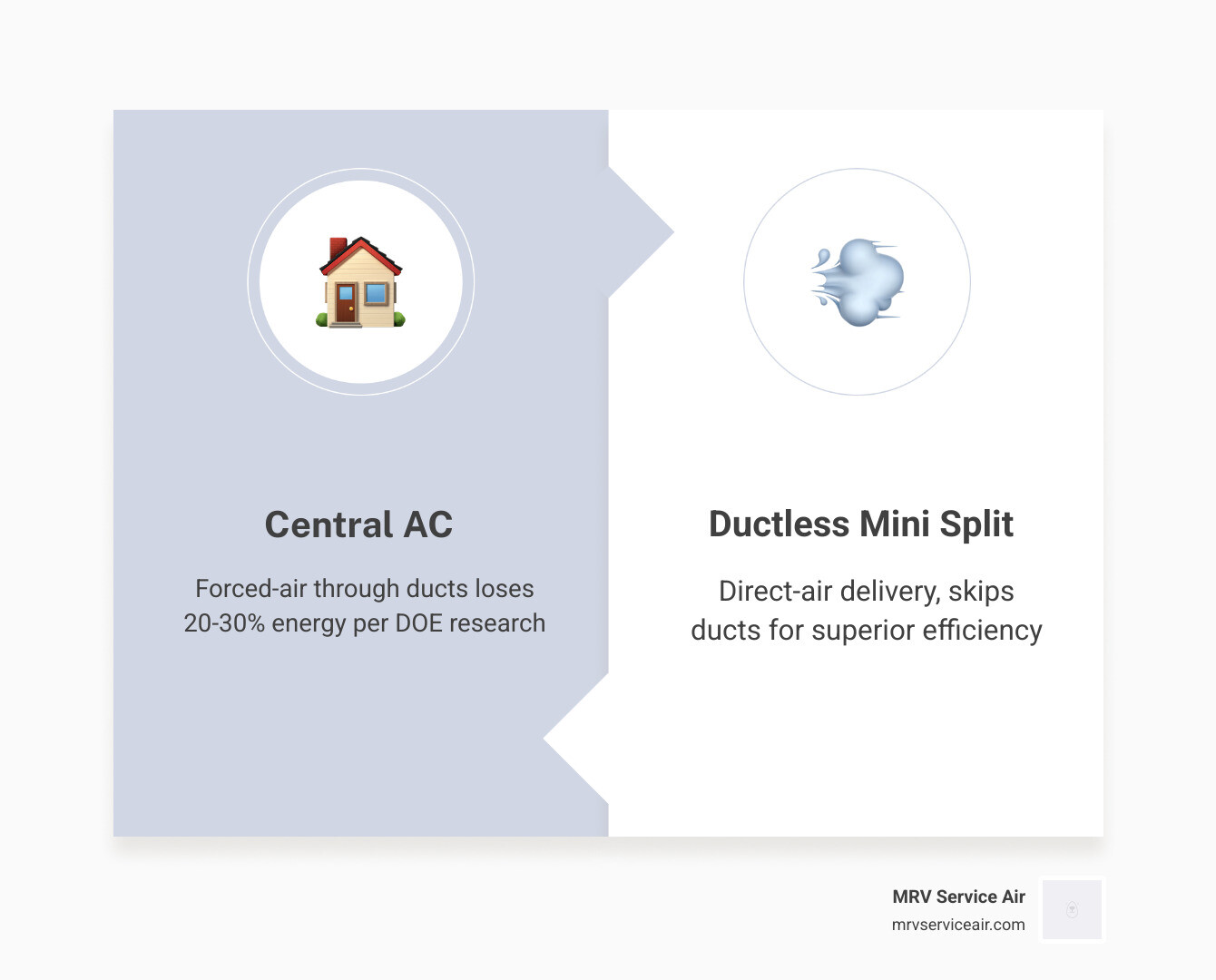
Understanding the Central AC vs Ductless Mini Split Comparison
To make an informed choice, we first need to look at how these systems actually function. At their core, both systems rely on the same scientific principle: heat transfer. They use an outdoor condenser unit and an indoor evaporator coil connected by refrigerant lines to pull heat out of your indoor air and dump it outside.

However, the “delivery” is where the central ac vs ductless mini split comparison gets interesting. Central systems are often referred to as “forced-air” systems. They use one large indoor air handler (usually tucked away in a closet or attic) to push air through a complex network of metal or flexible ducts. If you are looking for a whole-home solution and already have a duct network in place, More info about central HVAC services can help you understand how modern upgrades fit into your existing structure.
Ductless mini splits, on the other hand, use “inverter technology.” This allows the system to vary the speed of the compressor rather than simply turning it on and off. Imagine a car: central AC is like a driver who either has the pedal to the floor or the brake on. A mini split is like a driver using cruise control, adjusting slightly to maintain a perfect speed. This leads to much steadier temperatures and significantly lower energy consumption. For those without ducts or looking to cool specific zones, More info about ductless HVAC explains how these independent air handlers work.
Efficiency Gains in a Central AC vs Ductless Mini Split Comparison
As of April 2026, efficiency is no longer just a “nice to have”—it is a necessity for managing utility bills in Central California. When we look at the central ac vs ductless mini split comparison, ductless systems almost always win the efficiency battle.
The primary reason is the elimination of duct loss. Think of it like buying a gallon of milk but having 30% of it leak out of the bag before you get home. That is exactly what happens with many central systems; the air is cooled perfectly at the unit, but it warms up as it travels through leaky, uninsulated ducts in a 140-degree attic.
- SEER2 Ratings: Modern mini splits frequently achieve ratings between 18 and 30+ SEER2, while standard central units typically hover between 13 and 18 SEER2.
- Variable Speed: Because mini splits use inverter-driven compressors, they don’t experience the “power surge” of a traditional AC unit kicking on, which saves a massive amount of electricity over time.
If you are concerned about your home’s carbon footprint or your monthly overhead, More info about energy efficiency services can provide a roadmap for maximizing these savings.
Zoning Flexibility in a Central AC vs Ductless Mini Split Comparison
One of the most common complaints we hear from homeowners in Delano is that the upstairs is sweltering while the downstairs is a walk-in freezer. This is where the central ac vs ductless mini split comparison favors the ductless route.
Mini splits offer built-in “zoning.” Each indoor unit (or “head”) has its own thermostat. This means you can keep your home office at a crisp 70 degrees while leaving the guest room uncooled to save energy. In a central system, you generally have one thermostat controlling the whole house. While you can add “dampers” to a central system to create zones, it is often a complex and expensive retrofit.
With More info about mini-split HVAC, you can see how multi-zone setups allow for customized comfort that adapts to your family’s daily routine, rather than cooling every square inch of the house 24/7.
How Ductwork and Installation Impact Your Choice
The physical state of your home is often the ultimate tie-breaker in the central ac vs ductless mini split comparison.
If your home was built in the 1990s or later, you likely have an existing duct network. If those ducts are in good condition—meaning they are well-sealed and properly sized—sticking with a central AC replacement is often the most straightforward path. However, if your ducts are over 15-20 years old, they may be full of leaks, dust, and gaps.
More info about duct work is essential here because if your ducts are failing, even the most expensive, high-efficiency central AC unit will perform poorly. In some cases, the cost of repairing or replacing all the ductwork in a home can actually be higher than simply switching to a multi-zone ductless system.
For homes without any existing ducts—such as historic homes in the Delano area or new room additions—the choice is much clearer. Installing new ducts requires tearing into drywall, lowering ceilings, and losing closet space. More info about ventilation work and More info about planning and design highlights why a mini split is the “low-impact” choice. A mini split installation typically only requires a small 3-inch hole in the exterior wall to pass the refrigerant and condensate lines through, making the process much faster and less messy.
Performance, Aesthetics, and Noise Considerations
How a system looks and sounds inside your home is a major part of the central ac vs ductless mini split comparison.
Central AC is the “invisible” option. All you see are small grates (registers) on the floor or ceiling. For homeowners who have spent a lot of time on their interior design and don’t want a piece of equipment on the wall, central AC is often preferred.
However, mini splits have come a long way. While the standard wall-mounted white box is the most common, there are now floor-mounted units that look like heaters, and “ceiling cassettes” that sit flush with the ceiling.
When it comes to noise, mini splits are the clear winners. They are often described as “whisper-quiet,” operating at decibel levels between 19 and 26 dB. To put that in perspective, a library is usually around 30 dB. Central AC systems aren’t necessarily “loud,” but you will definitely hear the “whoosh” of air moving through the vents and the clatter of the unit turning on. If silence is a priority for your bedroom or home office, check out More info about AC service in Bakersfield and Delano to compare the latest quiet-run models.
| Feature | Central AC | Mini Split |
|---|---|---|
| Visual Presence | Invisible (only vents) | Visible wall/floor units |
| Noise Level | 40-60 dB (indoor) | 19-26 dB (indoor) |
| Air Distribution | High-velocity vents | Gentle, direct flow |
Maintenance, Air Quality, and System Longevity
Maintenance is the “secret sauce” to making any HVAC system last. In the central ac vs ductless mini split comparison, the tasks differ significantly.
- Central AC: Maintenance usually involves changing one or two large filters every 1 to 3 months and having the ducts professionally cleaned every few years. Because central systems can accommodate thick, pleated HEPA filters, they are often better for families with severe allergies. More info about indoor air quality can help you decide if a whole-home filtration system is right for you.
- Mini Splits: These units have smaller filters that need to be rinsed out by the homeowner every 2 to 4 weeks. Because the units are in the living space, they can collect dust more quickly. However, they don’t have ducts where mold and dander can hide.
Both systems have a typical lifespan of 15 to 20 years, provided they receive an annual professional tune-up. If your system also handles your winter needs, you’ll want to look at More info about furnace services or More info about heat pump services to ensure year-round reliability.
In Central California, our heating needs are moderate, but they still exist. Many mini splits are actually heat pumps, meaning they can reverse the cooling process to provide highly efficient heat during chilly Delano nights. For more on how these systems handle our local winters, see More info about heating systems. And before you pull the trigger on a new installation, always check More info about specials and rebates to see how you can maximize your investment.
Frequently Asked Questions
Can I use both central AC and mini-splits in the same home?
Absolutely! This is what we call a “hybrid” or “supplemental” setup. Many homeowners in Delano use their existing central AC for the main parts of the home but add a single-zone mini split to a garage conversion, a sunroom, or a master bedroom that never seems to get cool enough. This prevents you from having to overwork your main system just to cool one “problem” room. If you’re considering a mixed approach, More info about HVAC contractor services can help you plan the layout.
Which system is better for older homes without ducts?
For historic or older homes, the central ac vs ductless mini split comparison almost always leans toward the mini split. Preserving the architectural integrity of a classic home is difficult when you have to drop ceilings or cut into plaster walls to fit large ducts. Ductless systems allow you to keep your original walls and ceilings intact. You can find More info about ductless HVAC options that are specifically designed to be unobtrusive in older settings.
Are there federal tax credits available for these systems in 2026?
Yes! Under the Inflation Reduction Act, homeowners can qualify for federal tax credits of up to $2,000 for high-efficiency heat pump mini splits. Because these systems are so much more efficient than traditional air conditioners, the government provides these incentives to help offset the initial purchase. To see which models qualify for these 2026 incentives, look at More info about specials and rebates.
Conclusion
Choosing between central air and a mini split isn’t about finding the “best” system—it’s about finding the best fit for your specific home and lifestyle. If you have a large home with a healthy duct system, central AC offers a seamless, whole-home solution. If you live in an older home, have a new addition, or are tired of paying to cool rooms you don’t use, a ductless mini split is likely the smarter, more efficient choice.
At MRV Service Air, we’ve spent years helping the Delano and Bakersfield communities stay comfortable through some of the toughest summers on record. We pride ourselves on providing prompt, quality service at prices that make sense for your family. Whether you need a simple repair or a full system redesign, our team is here to ensure your home remains the sanctuary it’s meant to be.
Ready to find the perfect cooling solution for your home? Learn More About Our Air Conditioner Installation Services and let us help you beat the heat with a system tailored just for you.