







Why Is Your AC Blowing Warm Air in the Central Valley?
If you’re wondering why is my AC blowing warm air in the Central Valley, here are the most common reasons:
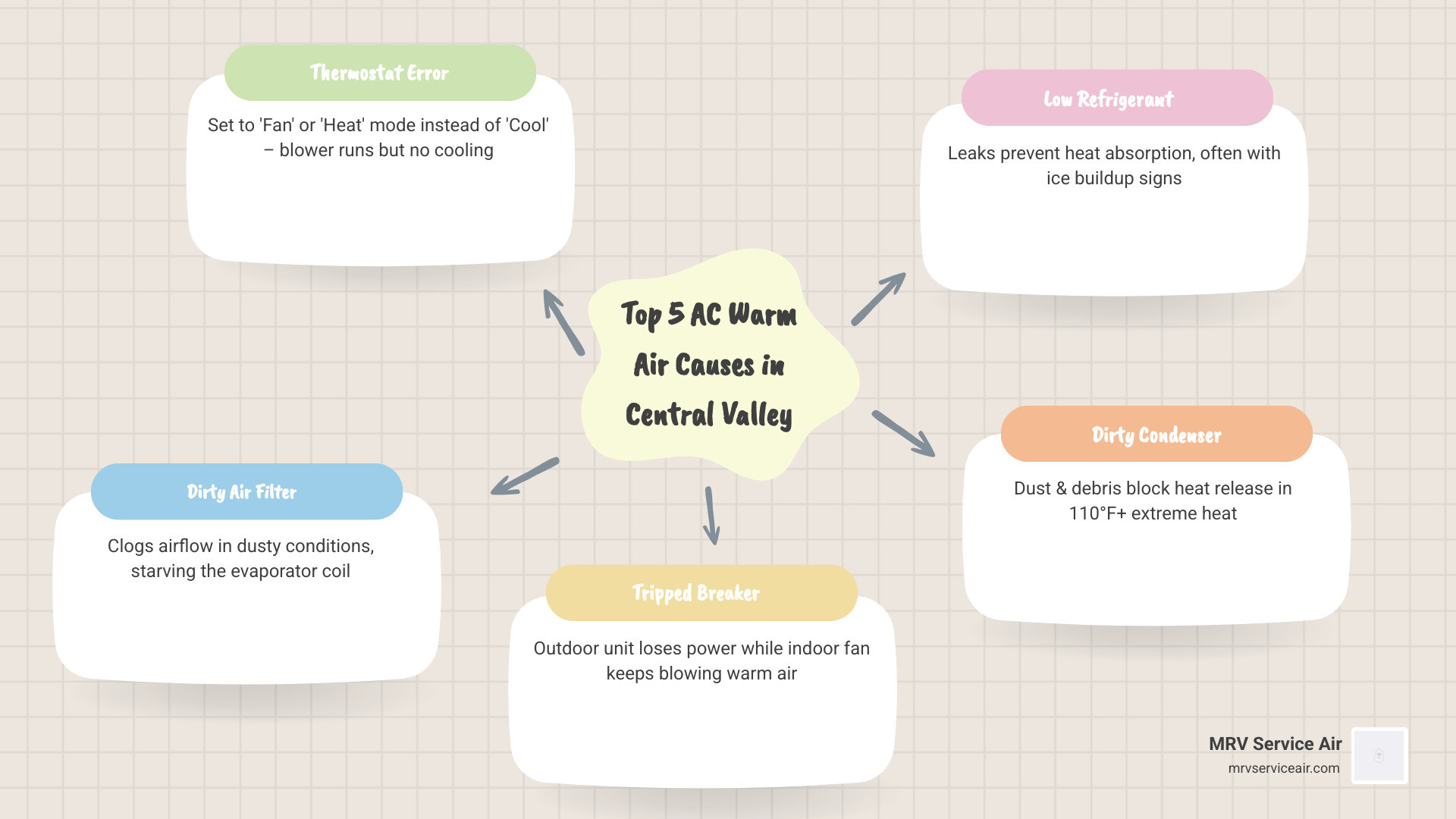
- Thermostat set to “Fan” or “Heat” instead of “Cool” — the blower runs but no cooling happens
- Dirty or clogged air filter — restricts airflow and shuts down effective cooling
- Tripped circuit breaker — the indoor fan runs while the outdoor unit loses power
- Low refrigerant due to a leak — the system can’t absorb heat properly
- Dirty condenser coils or blocked outdoor unit — heat can’t escape outside
- Frozen evaporator coil — ice buildup stops cold air from reaching your vents
- Leaky ductwork — hot attic air mixes with cooled air before it reaches you
- Failed capacitor or compressor — the outdoor unit stops working entirely
When your thermostat reads 72°F but your house feels like 82°F, something has gone wrong inside your cooling system. In the Central Valley, that gap between what your AC promises and what it actually delivers can feel even more brutal — especially when outdoor temperatures push past 110°F and the air is thick with agricultural dust.
The good news is that some causes are simple fixes you can handle in minutes. Others need a licensed technician before they turn into a full system failure. This guide walks you through both, so you know exactly what you’re dealing with and when it’s time to make the call.
Why is my ac blowing warm air in the central valley terms to remember:
- Which contractors in Delano specialize in new central air conditioning installation and setup?
- how to know if your ac is going bad
Why Is My AC Blowing Warm Air in the Central Valley?
Warm air from the vents usually comes down to one of three categories:
- A control problem, like thermostat settings or power loss
- An airflow problem, like a clogged filter or blocked return
- A mechanical problem, like low refrigerant, a bad capacitor, or compressor trouble
In our area, those problems get worse fast because Central Valley summers are hard on equipment. Long run times, blowing dust, and intense afternoon heat can turn a small issue into a sweaty emergency.
For a deeper look at how local conditions affect equipment, see Why the Valley’s Dust and Heat Are Your AC’s Worst Enemies.
| Minor issue often found first | Major issue usually needs professional repair |
|---|---|
| Thermostat on Fan instead of Cool | Refrigerant leak |
| Dirty air filter | Failed capacitor or contactor |
| Closed supply vents | Compressor trouble |
| Furniture blocking a return vent | Electrical fault at outdoor unit |
| Debris around condenser | Severe duct leakage |
| Dead thermostat batteries | Frozen coil caused by deeper system issue |
The most common warm air causes in Central Valley homes
The issues we see most often are the basics:
- Thermostat accidentally set to
Fan On - Thermostat set to
Heatinstead ofCool - Air filter packed with dust
- Return vent blocked by furniture, boxes, or rugs
- Outdoor unit breaker tripped
- Outdoor condenser clogged with dirt, weeds, or debris
- Low refrigerant from a leak
- Compressor or capacitor failure
A good rule of thumb: if air is moving but not cooling, the indoor blower may still be working while the outdoor cooling side is not.
How Central Valley heat and dust push AC systems past their limits
The Central Valley is not gentle on air conditioners. Extreme heat increases the cooling load on your home, while dust coats filters, coils, and outdoor units. That combination can lead to:
- Longer run times
- Reduced airflow
- Poor heat transfer
- Higher indoor humidity
- Rising energy use
- More wear on motors and compressors
Farm dust, dry soil, and windy afternoons can quickly clog a filter or coat a condenser coil. When the outdoor unit cannot release heat effectively, your system may run and run without actually cooling much.
For more local guidance, read Valley Dust Vs Your Hvac A Survival Guide and The Science Of Sweat What Happens To Your Ac When Its 110 Degrees.
Start Here First: Safe Troubleshooting Before You Call
Before assuming the whole system has failed, start with a few safe checks.
The first 6 things to check:
- Thermostat mode and temperature setting
- Thermostat batteries, if applicable
- Air filter condition
- Open supply vents and clear return vents
- Breakers for the indoor and outdoor units
- Outdoor condenser for visible blockage or dirt
If you make a simple correction, give the system about 30 minutes to respond. If it still blows warm air after that, it is probably time for service.
Check thermostat settings before assuming the AC is broken
Thermostat mistakes are more common than most homeowners think. We have seen plenty of cases where the system was not broken at all. It was just told to do the wrong thing.
Check for these:
- Set system mode to
Cool - Set fan to
Auto, notOn - Lower the setpoint at least several degrees below room temperature
- Replace batteries if the thermostat uses them
- Watch for a blank screen or error message
Why does Fan On matter? Because that setting can keep the blower moving air even when the AC is not actively cooling. That air may feel warm or room temperature, especially during a hot afternoon.
Why is my AC blowing warm air in the Central Valley even though the fan is running?
This is one of the most common and confusing situations.
Your indoor unit has a blower fan that pushes air through the ducts. Your outdoor unit contains the condenser and compressor that actually remove heat from your home. If the outdoor unit loses power or fails to start, the blower may still run, making it seem like the AC is halfway working.
Possible causes include:
- Tripped breaker for the outdoor unit
- Failed capacitor
- Bad contactor
- Compressor failure
- Disconnect switch issue near the condenser
If the thermostat calls for cooling and you hear the indoor fan but the outdoor unit is silent, that is a strong clue the problem is outside or electrical.
Air filter, return vents, and supply vents can choke cooling fast
Airflow problems can make a healthy AC act sick.
Check these areas:
- Air filter: if it looks gray, dusty, or packed, replace it
- Return vents: make sure they are not blocked by couches, cabinets, curtains, or storage
- Supply vents: open them and make sure they are not shut or covered
A clogged filter restricts airflow, which can reduce cooling and even contribute to frozen evaporator coils. Blocked returns can starve the system for air. Closed vents do not usually save money, either. They often create airflow imbalance and make the system work harder.
For seasonal prep, see A Central Valley Ac Readiness Checklist To Keep You Cool.
How to safely inspect the outdoor unit for blockage and dirt
Your outdoor condenser needs room to breathe. In dusty Central Valley conditions, it also needs regular visual checks.
Safely inspect it this way:
- Turn off power to the system at the thermostat and disconnect if you are doing any cleaning
- Remove leaves, weeds, grass, and loose debris around the unit
- Maintain about 2 feet of clearance around the condenser
- Look for dirt coating the coil fins
- If only surface dirt is present, gently rinse with a hose from the outside in
Avoid:
- Pressure washers
- Scrubbing fins aggressively
- Opening electrical panels
- Reaching into the unit while power is on
Bent fins, heavy buildup, or oily residue are signs to stop and call for help.
More local maintenance help: How To Maintain Your Ac In Extreme Heat And Dust
Airflow and Coil Problems That Commonly Cause Warm Air
When airflow drops, coil problems usually follow. Your system depends on moving enough air across the evaporator coil indoors and releasing enough heat at the condenser outdoors. Restrict either side, and cooling suffers.
Why a dirty air filter is one of the top causes in dusty Central Valley conditions
This is one of the easiest fixes and one of the most overlooked.
Filters protect the system from dust and help maintain proper airflow. In clean conditions, many filters last 1 to 3 months. In the Central Valley, especially with dust, pets, allergies, or frequent AC use, that schedule may need to be shorter.
We recommend:
- Check the filter monthly during cooling season
- Replace it when visibly dirty
- Expect more frequent changes during dusty or windy periods
A dirty filter can cause:
- Weak airflow
- Warm or barely cool air at vents
- Longer run times
- Higher energy use
- Stress on the blower motor
- Frozen evaporator coils
What frozen evaporator coils mean and what to do if you see ice
Ice on the refrigerant line or indoor coil is a warning sign, not a weird bonus cooling feature. If the evaporator coil freezes, air cannot move properly and the system may start blowing warm air.
Common causes:
- Dirty air filter
- Blocked return airflow
- Low refrigerant
- Blower problems
What to do:
- Turn the AC cooling off
- If your thermostat allows it, switch the fan to
Ontemporarily to help thaw the coil - Check and replace the filter
- Do not chip at the ice
- Call for service if ice returns or if you suspect refrigerant issues
If you see ice more than once, there is usually an underlying problem that needs professional diagnosis.
How dirty condenser coils keep your AC from releasing heat outside
Your AC does not create cold so much as it removes heat from inside your home and dumps it outdoors. The condenser coil is where that outdoor heat release happens.
If the coil is covered in dust and grime:
- Heat gets trapped in the system
- Cooling capacity drops
- Run times get longer
- Pressure rises inside the system
- Compressor strain increases
In our area, a dusty condenser can happen surprisingly fast. Even a unit that looked okay in spring can be struggling by midsummer.
Refrigerant, Ductwork, and Electrical Failures That Need Professional Help
Some problems are not safe or realistic for DIY repair. Once refrigerant, hidden duct leakage, or electrical components are involved, it is time to bring in trained help.
If your system quits during a heat wave, these Emergency Ac Repair Tips For Central Valley Homeowners can help you stay safe while you wait for service.
Why is my AC blowing warm air in the Central Valley when refrigerant is low?
Refrigerant is what absorbs heat from your indoor air. If the charge is low, the system cannot cool properly.
Important point: refrigerant is not something your AC “uses up” like fuel. If it is low, there is usually a leak.
Signs of low refrigerant include:
- Warm or mildly cool air from vents
- Longer cooling cycles
- Ice on the evaporator coil or refrigerant lines
- Hissing or bubbling sounds
- Poor humidity removal
This requires professional repair because the leak must be located and fixed before the refrigerant is recharged. Refrigerant handling also involves pressurized components and regulated materials.
How duct leaks or blocked returns make cool air feel warm
Even if the AC itself is working, damaged ductwork can ruin delivery.
Leaky ducts in an attic or crawlspace can:
- Pull in hot air from surrounding spaces
- Lose cooled air before it reaches rooms
- Cause uneven temperatures
- Make some vents feel barely cool
- Increase energy use
Blocked returns create a different but related problem. If the system cannot pull enough indoor air back to the unit, airflow falls and cooling performance drops.
Clues that point to duct issues:
- Some rooms are hot while others are okay
- Weak airflow from certain vents
- Dusty attic smell from vents
- Whistling or rattling sounds
- High cooling bills with poor comfort
Electrical issues that stop cooling while the blower still runs
Electrical faults are another major cause of warm air, especially when the indoor fan is still moving air.
Common examples:
- Tripped breaker
- Failed capacitor
- Bad contactor
- Loose or damaged wiring
- Compressor electrical failure
A capacitor helps start and run motors. If it fails, the outdoor unit may hum, click, or do nothing at all. A tripped breaker may restore function once, but if it trips again, there is an underlying problem. Repeated resets are not the fix.
Call right away if you notice:
- Burning smells
- Buzzing or loud humming
- Repeated breaker trips
- Outdoor unit not starting
- System short cycling
When to Call a Professional and How to Prevent It Next Time
Basic troubleshooting is helpful, but there is a clear point where continuing to experiment is just sweating with extra steps.
Call for professional help if:
- Warm air continues after thermostat, filter, vent, and breaker checks
- You see ice on the coil or refrigerant lines
- You hear hissing, buzzing, or grinding
- The breaker trips again
- The outdoor unit will not run
- You smell something burning
- Airflow is weak throughout the house
- Humidity indoors feels unusually high
Signs the problem is minor versus signs it could be major
Minor issues often include:
- Wrong thermostat setting
- Dead thermostat batteries
- Dirty air filter
- Closed vents
- Furniture blocking a return
Major issues often include:
- Refrigerant leak
- Repeated ice buildup
- Outdoor unit completely silent
- Loud humming or hard starting
- Burning odor
- Repeated breaker trips
- Compressor trouble
The difference matters because minor issues can often be corrected in minutes, while major ones can damage the system if ignored.
Why ignoring warm air can lead to bigger system damage
A warm-air problem rarely fixes itself. Usually it gets more expensive in comfort, wear, and system strain.
Ignoring it can lead to:
- Higher energy bills
- Longer run times
- Poor humidity control
- More stress on the blower and compressor
- Full breakdown during peak heat
That last one is the real Central Valley plot twist: the system limps along until the hottest week of the year, then waves a white flag.
Seasonal maintenance tips for Central Valley homeowners
The best way to prevent warm-air surprises is steady maintenance before peak summer.
We recommend:
- Schedule a spring AC tune-up
- Check filters monthly during heavy use
- Keep returns unobstructed
- Keep all vents open unless we advise otherwise
- Maintain clearance around the condenser
- Rinse light outdoor dust buildup when safe
- Have coils, refrigerant levels, electrical components, and drainage checked professionally
- Ask about duct inspection if airflow is uneven
- Add shade near the outdoor unit only if it does not block airflow
More local reading:
- The Complete Bakersfield Guide To Getting Your Ac Fixed Fast
- Delano Ac Repair Because Melting Is For Ice Cream
- How To Handle Air Conditioning Repair In Earlimart Without Losing Your Cool
Frequently Asked Questions About Warm Air From Your AC
How long should I wait after basic troubleshooting before calling for service?
If you corrected the thermostat setting, changed the filter, opened vents, and checked the outdoor unit, give the system about 30 minutes. If it is still blowing warm air, call for service.
How often should I replace my AC filter in the Central Valley?
Check it every month during cooling season. Many homes need replacement every 1 to 3 months, but dusty conditions, pets, allergies, and heavy summer use can shorten that timeline.
Can I keep running my AC if it is blowing warm air?
Not for long. If the system is blowing warm air continuously, shut it down after basic checks and call for help. Running it too long can increase compressor strain and worsen icing or electrical problems.
Conclusion
If you have been asking why is my AC blowing warm air in the Central Valley, start with the simple stuff: thermostat settings, filter condition, vent airflow, breaker status, and outdoor debris. If those do not solve it quickly, the issue may involve refrigerant, coils, ductwork, or electrical components that need professional attention.
At MRV Service Air, we help homeowners across Delano, Bakersfield, Porterville, Earlimart, Wasco, Shafter, Richgrove, Kern, and Tulare get back to reliable cooling with prompt, quality service at affordable prices. If your system is running but not cooling, or if it has stopped keeping up with the heat, our team is ready to help.
Learn more about our local cooling solutions here: More info about AC services