







Why Knowing How to Prepare Your HVAC for Central Valley Summer Could Save You This Season
Knowing how to prepare your hvac for central valley summer is one of the most important things you can do as a homeowner before temperatures climb past 100°F. Here in the San Joaquin Valley, summers are not just hot — they are relentless. Systems that ran fine in April can struggle or fail completely by July, often because of the Valley’s unique combination of agricultural dust, heat domes, and weeks of triple-digit temperatures.
Here’s a quick summary of the 5 key steps to prepare your HVAC for Central Valley summer:
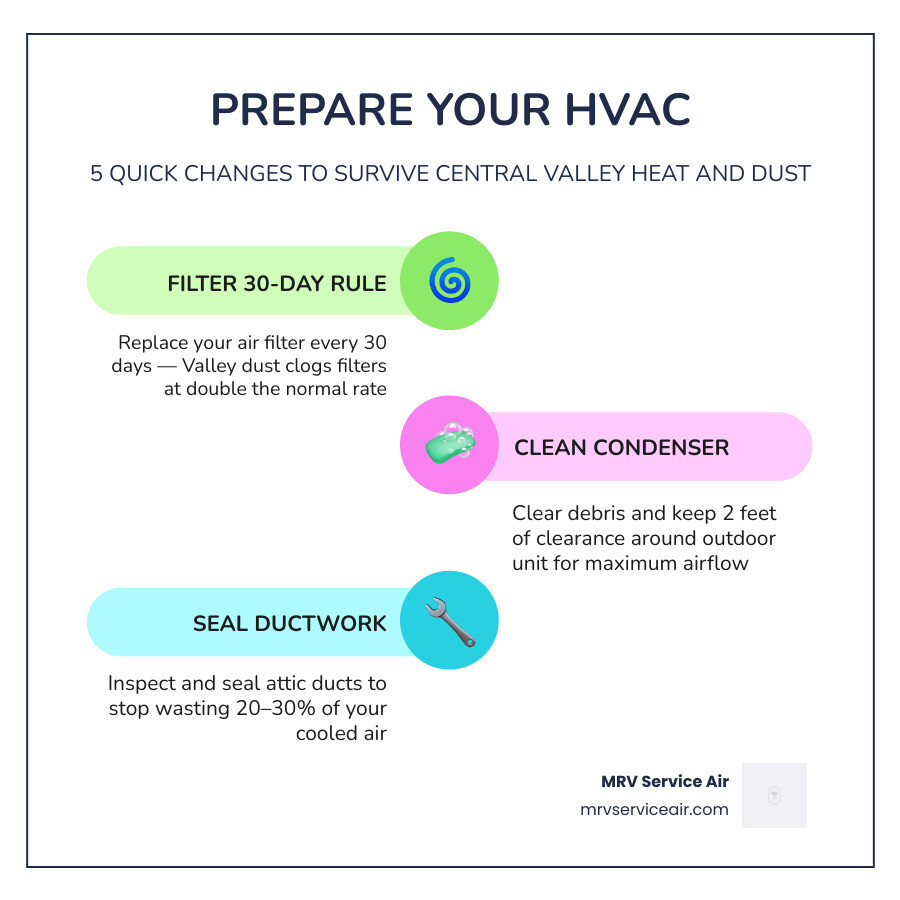
- Replace your air filter every 30 days — Valley dust clogs filters at double the normal rate
- Clear and clean your outdoor condenser unit — remove debris and maintain at least 2 feet of clearance
- Optimize your thermostat settings — set to 78°F when home; consider a smart thermostat upgrade
- Inspect and seal your attic ductwork — leaky ducts can waste 20–30% of your cooled air
- Schedule a professional spring tune-up — before the seasonal rush hits in May and June
Most homeowners don’t realize how much the Central Valley’s agricultural environment stacks the odds against their AC. Harvest-season dust, fine PM2.5 particles, and heat domes that block overnight relief create one of the harshest climates for HVAC systems in the country. A system that might last 20 years in a milder region could start failing in under a decade here without the right care.
The good news? A handful of focused changes made before summer arrives can dramatically reduce your risk of a breakdown — and keep your energy bills from spiraling when your system is working its hardest.
Why You Must Know How to Prepare Your HVAC for Central Valley Summer
Central Valley summer is not “normal summer.” In Delano, Wasco, Shafter, Richgrove, Earlimart, Porterville, Tulare, Bakersfield, and surrounding Kern and Tulare County communities, your cooling system deals with a tough mix of:
- Triple-digit outdoor temperatures
- Long cooling seasons that can stretch from spring into fall
- Agricultural dust and field debris
- Wildfire smoke and PM2.5 particles
- Superheated attics
- Heat domes that prevent nighttime cooling relief
- AC run times that can stretch for hours during peak heat
That combination affects more than comfort. It affects airflow, refrigerant pressures, electrical components, compressor stress, indoor air quality, and monthly energy use.
Think of your AC like a runner. A clean, maintained system is jogging with good shoes and plenty of water. A dirty, neglected system is running uphill in boots while carrying a backpack full of dust. It might keep going for a while, but eventually something gives.
Agricultural dust is especially hard on Valley HVAC systems because it is heavier and more abrasive than ordinary household dust. It clogs filters, coats coils, and reduces the system’s ability to move heat out of your home. Even a small amount of dust buildup on coils can reduce cooling performance significantly, and research-backed HVAC guidance shows that a dirty filter can increase energy consumption by 5% to 15% or more.
Extreme heat adds another challenge. Most residential air conditioners are designed to reduce indoor temperature by about 20 degrees compared with the outdoor temperature under heavy load. So when it is 105°F outside, your AC may be working hard just to keep the house near the mid-80s if the system is dirty, undersized, low on refrigerant, or losing air through ducts.
For a deeper look at why our local climate is so tough on cooling systems, we recommend reading Why the Valley’s Dust and Heat Are Your AC’s Worst Enemies and The Science of Sweat: What Happens to Your AC When It’s 110 Degrees.
Step 1: Master the 30-Day Filter Rule and Learn How to Prepare Your HVAC for Central Valley Summer
If you do only one homeowner task this summer, make it this: check your air filter every 30 days.
In milder areas, some filters may last longer. In the Central Valley, especially near farmland, dirt roads, orchards, open fields, or windy areas, that timeline often does not hold up. During May through September, a 30-day filter check is one of the simplest ways to protect your AC.
A clogged filter causes trouble because it restricts airflow. When airflow drops, your system has to work harder to pull air through the return side and push cooled air into your rooms. That can lead to:
- Longer run times
- Higher energy use
- Weak airflow from vents
- Frozen evaporator coils
- Blower motor strain
- Hot and cold spots in the home
- Dustier indoor air
- Greater wear on the system
For many Central Valley homes, a MERV 8 to MERV 11 filter provides a good balance between capturing dust and maintaining airflow. Higher is not always better. A filter that is too restrictive for your system can choke airflow, especially if your ductwork or blower is not designed for it. When in doubt, use the filter type recommended for your equipment or ask us during your maintenance visit.
Here is a simple filter routine:
- Check the filter every 30 days during summer.
- Replace it sooner if it looks gray, dusty, matted, or clogged.
- Replace it more often if you have pets, allergies, nearby agriculture, or recent smoke exposure.
- Make sure the airflow arrow on the filter points in the correct direction.
- Keep a few replacement filters at home before the first heat wave hits.
A clean filter does not just protect your equipment. It can also help your system cool more evenly and use less electricity. Some homeowners see meaningful energy savings simply by staying consistent with filter changes and maintenance.
For more Valley-specific filter and dust guidance, visit How to Maintain Your AC in Extreme Heat and Dust.
Step 2: Clear and Clean Your Outdoor Condenser Unit to Prepare Your HVAC for Central Valley Summer
Your outdoor condenser is where your AC releases heat from inside your home. If the outdoor unit is covered in dust, leaves, grass clippings, weeds, spider webs, or cottony debris, it cannot release heat efficiently.
That matters because your AC does not “make cold” as much as it removes heat. When the condenser coil is dirty, the heat has a harder time leaving the system. The result can be higher pressure, longer run times, warmer indoor air, and more strain on the compressor.
Before summer, give the outdoor unit some breathing room:
- Clear at least 2 feet of space around the condenser.
- Trim back weeds, shrubs, vines, and tall grass.
- Remove leaves, seed pods, trash, and debris around the base.
- Check after wind events, especially near fields or open lots.
- Keep sprinklers from spraying the unit regularly.
- Do not stack items against the unit.
- Never cover the unit while it is running.
You can also gently rinse the condenser fins with a garden hose. Turn the system off first, then spray gently from the outside to remove loose dirt. Avoid pressure washers. Condenser fins are thin aluminum and can bend easily. Bent fins restrict airflow, which is the opposite of what we want.
Leave deeper coil cleaning, electrical checks, refrigerant testing, capacitor inspection, and fan motor evaluation to a professional. Outdoor units contain high-voltage components and sealed refrigerant circuits, so this is not the place for adventurous weekend experiments. Your AC is not a lawn chair. Please do not poke it with tools and hope for the best.
Three More Essential Changes for Peak Summer Efficiency
Filters and condenser cleaning are the foundation, but they are not the whole picture. If you want your system to survive Central Valley heat with less stress, you also need to think about thermostat strategy, ductwork, and household cooling habits.
These changes help your AC work smarter, not harder. That can improve comfort, reduce energy waste, and support a longer system lifespan. Routine maintenance can improve HVAC efficiency by as much as 20%, and homeowners who keep up with AC care often report energy bill reductions in the 15% to 25% range after professional service and system cleaning.
Step 3: Optimize Thermostat Settings and Upgrade to Smart Controls
The thermostat is small, but it has a big say in how hard your AC works.
A good summer starting point is 78°F when you are home and awake. If that sounds warm, do not panic. Ceiling fans, closed blinds, and reduced indoor heat can make 78°F feel much more comfortable. When you are away, raising the temperature by 7 to 10 degrees can reduce energy use without forcing the system to run nonstop for an empty house.
Try these thermostat habits during Central Valley summer:
- Set the thermostat around 78°F when home.
- Raise the setting when away.
- Avoid dropping the thermostat extremely low when you come home.
- Use “auto” fan mode instead of “on” in most situations.
- Replace thermostat batteries every spring if your model uses them.
- Keep heat-producing appliances away from the thermostat.
- Make sure the thermostat is not in direct sunlight.
Here is the myth we want to retire: setting the thermostat to 65°F does not make your AC cool faster. It just tells the system to run longer. During a heat wave, that can push an already stressed system even harder.
A smart thermostat can help by automating temperature changes. Useful features include:
- Scheduling for work, school, and sleep routines
- Geofencing that adjusts settings when you leave or return
- Remote control from your phone
- Energy reports that show usage patterns
- Alerts for unusual run times or temperature issues
- Compatibility with multi-stage or variable-speed systems, where applicable
Programming your thermostat to raise the temperature while you are away can reduce annual cooling energy use. In Valley homes where the AC runs for long stretches, that matters.
Step 4: Inspect and Seal Your Attic Ductwork
Ducts are easy to forget because they are usually hidden in attics, crawl spaces, walls, or garages. But in Central Valley homes, ductwork can make or break cooling performance.
The average home can lose 20% to 30% of conditioned air through duct leaks. In a hot attic, that loss is even more painful. During summer heat waves, attic temperatures can climb extremely high, sometimes well above the outdoor temperature. If your ducts are leaking or poorly insulated, you may be paying to cool your attic instead of your bedrooms.
Signs your ductwork may need attention include:
- Some rooms are much hotter than others.
- Airflow is weak at certain vents.
- Energy bills rise even though thermostat habits stay the same.
- The AC runs constantly but comfort does not improve.
- The attic feels unusually drafty near ducts.
- You see disconnected, crushed, torn, or sagging duct sections.
- Dust builds up quickly indoors.
Homeowners can visually inspect accessible ducts, but sealing and testing are best handled professionally. Mastic sealant and proper HVAC-rated materials are usually preferred over temporary household tapes. Ductwork also needs to be sized and balanced correctly so the system can move the right amount of air.
| Ductwork condition | What happens in summer | Efficiency impact |
|---|---|---|
| Sealed and insulated ducts | Cooled air reaches rooms with less loss | Better comfort and lower system strain |
| Small leaks or loose connections | Some cooled air escapes into attic or crawl space | Longer run times and uneven rooms |
| Major leaks or disconnected ducts | Large amounts of cooled air never reach living spaces | Up to 20% to 30% of conditioned air can be wasted |
| Poor attic insulation around ducts | Air heats up before reaching rooms | AC works harder during peak heat |
If your AC seems strong at the equipment but weak at the vents, ductwork may be part of the problem.
Step 5: Use Ceiling Fans to Create a Wind-Chill Effect
Ceiling fans do not lower the temperature in a room. They cool people by moving air across the skin, creating a wind-chill effect. That means they are great comfort helpers, but only when people are in the room.
In summer, your ceiling fan should spin counterclockwise when viewed from below. This pushes air downward and helps you feel cooler. With fans running correctly, many homeowners can raise the thermostat a few degrees without feeling less comfortable.
Use fans the smart way:
- Set ceiling fans to counterclockwise in summer.
- Turn fans off when leaving the room.
- Use portable fans safely where extra airflow is needed.
- Keep interior doors open if it helps airflow balance.
- Do not block supply or return vents with furniture.
- Close blinds or curtains on sun-facing windows.
- Use ovens, dryers, and dishwashers later in the evening when possible.
- Keep windows closed while the AC is running.
These habits reduce the cooling load on your HVAC system. In plain English: the less heat your home gains, the less your AC has to wrestle with it.
Why Early Spring Professional Maintenance is Critical
Homeowner maintenance is important, but it cannot replace a professional AC tune-up. Before the first major heat wave, your system needs a full inspection from someone with the right tools, training, and safety procedures.
Early spring is the sweet spot. In our area, March and April are ideal, and May is still better than waiting until your AC is already struggling. Once the first major heat wave hits, service demand rises fast. By then, small issues may have already turned into urgent problems.
A professional spring tune-up typically includes checks such as:
- Inspecting and cleaning condenser components
- Checking refrigerant levels and system pressures
- Testing capacitors and electrical components
- Tightening electrical connections
- Measuring voltage and amperage
- Inspecting blower components
- Checking thermostat operation and calibration
- Clearing or checking condensate drain lines
- Evaluating airflow
- Looking for signs of worn or failing parts
- Checking system start-up and cooling performance
This matters because many summer breakdowns begin as small spring problems. A weak capacitor, dirty coil, low refrigerant condition, clogged drain, or loose electrical connection may not seem obvious in mild weather. Under 100°F-plus conditions, that same issue can cause a shutdown.
Routine maintenance can boost efficiency by as much as 20%, and a clean system generally uses less power than a neglected one. Proper care also helps protect equipment lifespan. A neglected HVAC system may begin failing much earlier, while a well-maintained system is more likely to reach its expected service life.
For a deeper checklist, see A Central Valley AC Readiness Checklist to Keep You Cool and Beat the Heat with These Essential Things to Do Before the Valley Sizzles.
Avoid the Summer Rush and Prevent Emergency Breakdowns
Waiting until the first heat wave to schedule AC service is like waiting until Thanksgiving morning to buy the turkey. You might get lucky, but it is not a plan we recommend.
During peak summer, HVAC systems across Delano, Bakersfield, Wasco, Shafter, Porterville, Tulare, Richgrove, and Earlimart are all under stress at the same time. That means more breakdown calls, more urgent repairs, and less flexibility in scheduling.
Early maintenance gives you several advantages:
- More time to correct small issues
- Better chance of avoiding mid-summer breakdowns
- Less stress during the first major heat wave
- Improved cooling performance before the system is pushed hard
- Better documentation of annual maintenance
- More consistent comfort during extreme temperatures
In especially dusty areas or for older systems, a second mid-summer check may also be helpful. This is especially true if you live near active farmland, open fields, or dirt roads, or if your system runs nearly nonstop during heat waves.
For guidance on tune-up timing in dusty conditions, visit How Often to Schedule Tune-Ups When the Dust Starts Flying.
Frequently Asked Questions About Central Valley HVAC Prep
Preparing your HVAC system before summer can feel like one more chore on a long homeowner list. We get it. The house already has opinions, and most of them involve maintenance. But a little attention now can prevent a lot of discomfort later.
Here are the questions we hear most often from Central Valley homeowners.
What are the warning signs that my AC needs immediate professional attention?
Call for professional service before summer if you notice any of the following:
- Weak airflow from vents
- Warm air blowing when the system is set to cool
- Strange noises such as grinding, squealing, banging, or rattling
- Burning smells or electrical odors
- Frequent short-cycling
- Ice on refrigerant lines or the indoor coil area
- Sudden unexplained increase in energy bills
- Water leaks around the indoor unit
- Breaker trips when the AC starts
- The system runs constantly but does not cool the home
- Some rooms stay hot no matter what you set the thermostat to
These symptoms can point to airflow problems, refrigerant issues, electrical component failure, duct leaks, dirty coils, or blower problems. The sooner a technician checks it, the better chance you have of preventing more serious damage.
If your system is already blowing warm air, read The Valley Heat Survival Guide: Why Your AC Is Blowing Warm Air for more troubleshooting context.
How often should I change my air filter during a Central Valley summer?
Check your filter every 30 days during the cooling season. Replace it monthly if it looks dirty or if your home has higher dust exposure.
You may need even more frequent changes if:
- You live near agricultural activity.
- You are close to a dirt road or open field.
- You have pets.
- Someone in the home has allergies or asthma.
- There has been wildfire smoke in the area.
- Your system runs for long periods every day.
- Your indoor air feels dusty or heavy.
The old 90-day filter rule is often too relaxed for our area. Valley dust and PM2.5 particles can load filters quickly, and a clogged filter forces your HVAC system to work harder right when you need it most.
What is the 20-degree rule for air conditioners?
The 20-degree rule means many residential air conditioners are designed to cool indoor air roughly 20 degrees below the outdoor temperature during heavy summer conditions.
For example:
- If it is 100°F outside, a healthy system may target around 80°F indoors.
- If it is 105°F outside, your home may struggle to get much below the mid-80s.
- If it is 110°F outside, even a good AC may run constantly to keep up.
This does not mean your AC is automatically broken if it cannot hold 72°F during extreme heat. But if it suddenly performs worse than usual, blows warm air, short-cycles, freezes, or cannot cool even modestly, it needs attention.
The 20-degree rule is also why preparation matters. A clean filter, clean coil, sealed ducts, proper refrigerant charge, and good airflow all help your AC get as close as possible to its intended performance.
For more on system strain during extreme heat, read Don’t Sweat It or Your AC Might Just Quit.
Conclusion
Learning how to prepare your hvac for central valley summer comes down to being proactive before the heat gets serious. Change the filter every 30 days. Clear and gently clean the outdoor unit. Use smart thermostat settings. Check ductwork. Run ceiling fans correctly. Most importantly, schedule professional maintenance early so your system is ready before triple-digit weather settles in.
At MRV Service Air, we help homeowners in Delano, Kern, Tulare, Porterville, Wasco, Shafter, Richgrove, Bakersfield, Earlimart, and nearby Central Valley communities stay comfortable with prompt, quality HVAC service at affordable prices. We provide air conditioning, heating, and financing services, and we understand how hard local heat and dust can be on your equipment.
Do not wait until the first major heat wave exposes a hidden problem. Schedule your professional Central Valley HVAC maintenance today and let us help keep your home cool when the Valley turns up the heat.