







Why SEER2 Ratings Have a Real Impact on Energy Bills in Hot Climates
Understanding how SEER2 ratings affect energy bills in hot climates is one of the most practical things a homeowner can do before buying a new AC system. In short: the higher your SEER2 rating, the less electricity your system uses to cool your home — and in a hot climate where your AC runs for months on end, that difference adds up fast.
Here’s a quick summary of how SEER2 impacts your energy bills:
- SEER2 is the current federal efficiency standard for air conditioners and heat pumps, replacing the older SEER rating in 2023
- A higher SEER2 number means the system uses less electricity to deliver the same amount of cooling
- In hot climates, AC systems run far more hours per year — so efficiency gains translate directly into bigger dollar savings
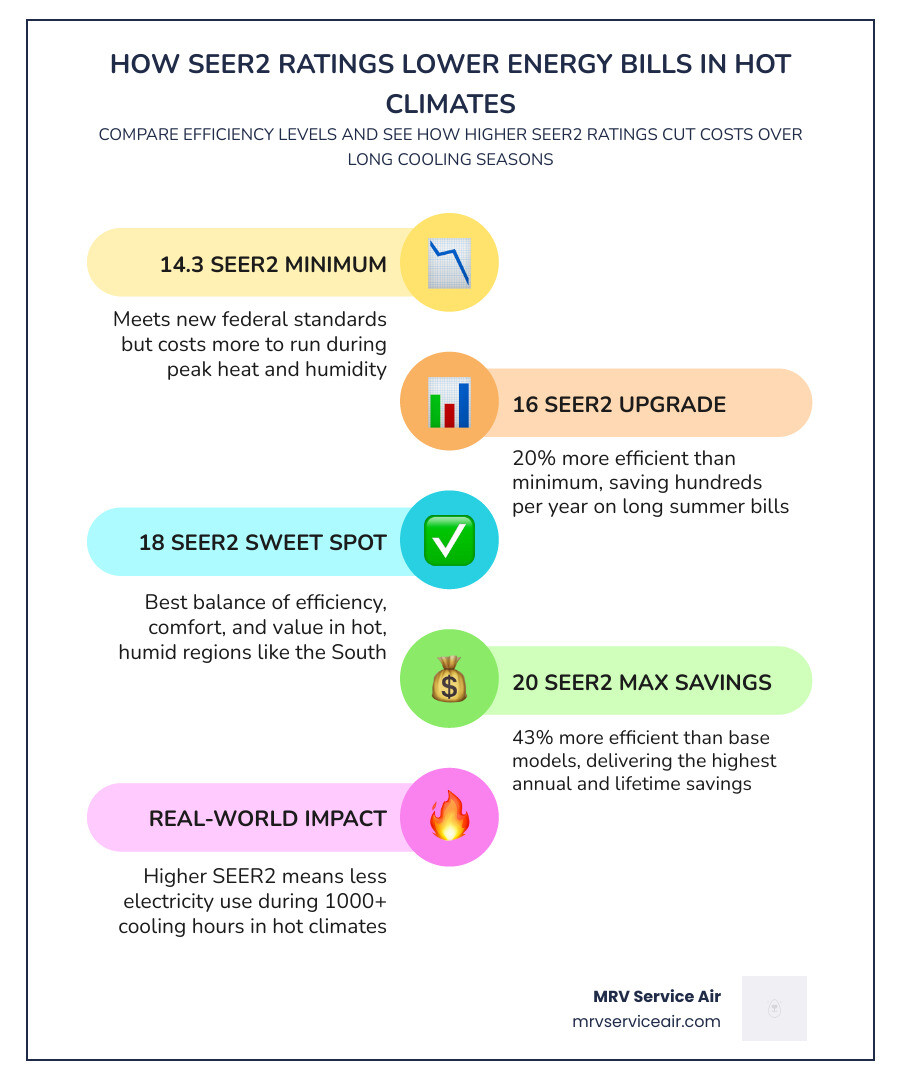
- An 18 SEER2 unit is roughly 20% more efficient than a 14 SEER2 unit
- A 20 SEER2 unit is roughly 43% more efficient than a 14 SEER2 unit
- Upgrading from a 14 SEER2 to an 18 SEER2 in a hot climate can save approximately $200–$400 per year on electricity
- Over a 15-year lifespan, that upgrade can mean $3,000–$4,500 in total savings
If you live somewhere like the San Joaquin Valley, the Gulf Coast, or the desert Southwest — where summers are long, brutal, and unforgiving — your SEER2 rating isn’t just a spec sheet number. It’s one of the biggest drivers of what you pay every single month from May through October.
The rest of this guide breaks down exactly how the math works, what the current minimum standards are for hot regions, and how to decide which SEER2 level actually makes sense for your home.
What SEER2 Means and Why It Replaced SEER
If you’ve been shopping for a new air conditioner lately in Delano or Bakersfield, you’ve likely noticed a new acronym: SEER2. For decades, we used the standard SEER (Seasonal Energy Efficiency Ratio) to measure how much cooling a unit produced compared to the energy it consumed. However, as of January 2023, the Department of Energy shifted the goalposts to SEER2.
What Is SEER2 and how seer2 ratings affect energy bills in hot climates
SEER2 stands for Seasonal Energy Efficiency Ratio 2. Like its predecessor, it measures the total cooling output of an AC unit over a typical cooling season divided by the total electric energy input during that same period. The “2” signifies that the testing procedure has been updated to reflect real-world conditions more accurately.
In our neck of the woods—Kern and Tulare County—how seer2 ratings affect energy bills in hot climates comes down to the sheer volume of work your AC does. Because our systems often run 12 to 16 hours a day during a July heatwave, even a small improvement in the SEER2 ratio can lead to a noticeable drop in your monthly utility bill.
How SEER2 differs from the original SEER rating
The biggest change between the old SEER and the new SEER2 is the “M1” testing procedure. In the old days, AC units were tested in a lab under conditions that didn’t really match a typical home. Specifically, they were tested with very low “static pressure” (the resistance air meets as it moves through your ducts).
The new SEER2 test increases this static pressure by five times (from 0.1 inches of water column to 0.5 inches). This is much closer to what a real HVAC system faces when trying to push air through the filters and ductwork in a home in Shafter or Wasco. Because the test is harder, the ratings are generally lower. A unit that was rated 15 SEER under the old rules might only be rated 14.3 SEER2 today, even though it’s the exact same piece of equipment.
Why SEER2 gives a more realistic picture for real homes
We like to think of SEER2 as the “real-world MPG” for your air conditioner. Just as a car gets different gas mileage on a flat highway versus a mountain climb, an AC unit performs differently when it has to fight through restrictive ductwork.
By accounting for this airflow resistance, SEER2 gives you a more honest estimate of what you’ll actually pay. For homeowners in hot, humid, or dusty environments—where filters get dirty quickly and ducts might be older—this new rating system helps ensure you aren’t overestimating your potential savings.

Why SEER2 Matters More in Hot and Humid Regions
In a mild climate where you only turn on the AC for three weeks in August, a high SEER2 rating is a luxury. But in the Central Valley, it’s a financial strategy.
Why how seer2 ratings affect energy bills in hot climates is different in the Southeast and Gulf Coast
While we deal with intense dry heat in places like Bakersfield, other regions face the double whammy of heat and humidity. In those climates, the AC isn’t just lowering the temperature; it’s pulling gallons of water out of the air. This “latent load” requires the system to run longer cycles.
Higher SEER2 units, especially those with variable-speed compressors, excel here. They can run at a lower, more consistent speed, which is much better for dehumidification than a standard unit that simply blasts on and off. This constant operation at high efficiency is exactly how seer2 ratings affect energy bills in hot climates most dramatically.
Hot dry vs hot humid climates: what changes in real efficiency
In our dry heat, we primarily focus on “sensible cooling”—lowering the actual temperature you see on the thermometer. In places like Phoenix or our own Valley floor, the system has to work incredibly hard to fight the sun’s radiant heat.
High-efficiency systems are designed to handle these “peak demand” periods without spiking your energy usage. When it’s 110 degrees in Delano, a lower SEER2 unit will struggle and consume massive amounts of power just to keep up. A high SEER2 unit, however, is built with more robust coils and advanced compressors that maintain their efficiency even when the mercury hits triple digits.
Minimum SEER2 requirements for new AC units in hot regions
The Department of Energy has split the U.S. into regions with different minimum standards. Because we live in the “Southwest” region (which includes California), we have stricter rules than the North.
As of May 2026, the current minimums for residential central air conditioners in our region are:
- Split Systems: 14.3 SEER2 (roughly equivalent to the old 15 SEER)
- Packaged Systems: 13.4 SEER2
It is illegal for contractors to install a system below these ratings in our area. However, just because 14.3 is the minimum doesn’t mean it’s the smartest choice for your wallet.
How to Calculate SEER2 Energy Savings on Monthly Bills
You don’t need a PhD in mathematics to figure out if a higher SEER2 rating is worth the investment. It all comes down to a simple comparison of energy consumption.
Simple formula for how seer2 ratings affect energy bills in hot climates
If you want to get technical, the formula for annual cooling cost is: (Total Cooling Load in BTUs / SEER2 Rating) / 1,000 * Hours of Operation * Electricity Rate per kWh
But an easier way to think about it is through percentages. If you upgrade from a 14.3 SEER2 to an 18 SEER2, you are improving your efficiency by about 20%. That means, theoretically, your cooling costs should drop by roughly 20%.
Comparing 14.3, 16, 18, and 20 SEER2 systems
The jump from the minimum standard to a premium unit can be staggering when you look at the long-term numbers.
| SEER2 Rating | Efficiency vs. 14.3 Baseline | Estimated Annual Savings (Hot Climate) |
|---|---|---|
| 14.3 SEER2 | Baseline (0%) | $0 |
| 16 SEER2 | ~11% More Efficient | $100 – $150 |
| 18 SEER2 | ~20% More Efficient | $200 – $400 |
| 20 SEER2 | ~43% More Efficient | $450 – $600 |
Note: Savings are estimates based on typical Central Valley cooling hours and average electricity rates.
What homeowners can realistically save after upgrading
Realistically, if you are upgrading from an old 10 SEER unit (common in many older homes in Porterville or Earlimart) to a modern 18 SEER2 system, you could see your summer cooling bills cut nearly in half.
Over a 15-year lifespan, choosing an 18 SEER2 unit over a 14.3 SEER2 model can save you between $3,000 and $4,500 in total energy costs. In some cases, the system literally pays for the price difference between the models within the first five to seven years.
The Factors That Can Shrink or Boost Real-World Savings
We’ve all heard the horror story: a homeowner spends top dollar on a 20 SEER2 system, but their energy bills barely budge. Why does this happen? Because the SEER2 rating is only a “potential” efficiency.
Why a high SEER2 rating alone does not guarantee low bills
The most common “efficiency killer” is poor installation. If a system is oversized (too big for the house), it will “short cycle,” turning on and off rapidly. This prevents it from ever reaching its peak efficiency and leaves your home feeling clammy. Conversely, an undersized unit will run 24/7 and still fail to keep you cool.
Furthermore, if your refrigerant charge is off or your airflow is restricted by crushed ducts, your 20 SEER2 unit might only be performing at a 12 SEER2 level. This is why we always emphasize that the quality of the install is just as important as the sticker on the box.
EER2, HSPF2, and other ratings that matter too
While SEER2 is the “seasonal” average, you should also look at EER2 (Energy Efficiency Ratio 2). EER2 measures how the unit performs specifically when it is 95°F outside. In the Central Valley, where we spend a lot of time at or above 95°F, a high EER2 is often a better indicator of how your bill will look in August.
If you are installing a heat pump, you’ll also want to look at HSPF2 (Heating Seasonal Performance Factor 2). This measures heating efficiency. Since our winters in Kern County are relatively mild, a high-efficiency heat pump can be an incredible way to save on both cooling and heating. You can learn more about heat pump benefits for Central Valley residents to see if this is the right move for your home.
Home upgrades that help high-SEER2 systems perform better
To get the most out of your investment, you need to look at the “whole house” as a system.
- Duct Sealing: Leaky ducts can waste up to 30% of your cooled air. If you don’t fix the leaks, you’re literally paying to cool your attic. Check out our duct work services in Delano for more information.
- Insulation: If your attic insulation is thin, heat will pour into your home, forcing the AC to work harder regardless of its SEER2 rating.
- Smart Thermostats: These help manage runtimes and ensure the system isn’t cooling an empty house.
- Maintenance: Regular filter changes and annual tune-ups are non-negotiable for maintaining efficiency. Our energy efficiency services can help you identify where your home is losing money.
Is a Higher-SEER2 System Worth It in a Hot Climate?
Is it worth the extra upfront cost? In a hot climate like ours, the answer is almost always “Yes,” but the “sweet spot” depends on your specific situation.
When minimum efficiency is enough and when it is not
If you are planning to sell your home in the next year or two, or if you are a landlord for a property where the tenant pays the utilities, you might be tempted to stick with the 14.3 SEER2 minimum. It gets the job done and meets the legal requirements.
However, if you plan to stay in your home for 10+ years, the minimum efficiency unit is rarely the best financial move. The “savings gap” over a decade is simply too large to ignore.
Why 16 to 18 SEER2 is often the sweet spot for hot climates
For most homeowners in Bakersfield or Tulare, the 16 to 18 SEER2 range offers the best “Return on Investment” (ROI). These units typically come with two-stage or variable-speed compressors. This means they don’t just have an “On” and “Off” switch; they can run at a lower power level when the weather is only 85°F, saving you a massive amount of energy compared to a single-stage unit that only knows how to run at 100% capacity.
When 18+ SEER2 makes the most sense
If you have a large home (over 2,500 square feet) or if you are particularly sensitive to humidity and temperature swings, the premium 20+ SEER2 units are fantastic. These systems provide the ultimate in comfort—whisper-quiet operation and incredibly stable indoor temperatures. They also qualify for the highest levels of federal tax credits and local utility rebates, which can help offset the higher initial price.
Frequently Asked Questions about how seer2 ratings affect energy bills in hot climates
Does a higher SEER2 unit cool the house faster?
No. A 3-ton unit with a 14.3 SEER2 rating and a 3-ton unit with a 20 SEER2 rating have the exact same cooling capacity. They both move the same amount of heat out of your house. The difference is that the 20 SEER2 unit uses significantly less electricity to do that work. It’s like two trucks carrying the same load; one just gets much better gas mileage.
Can I replace just the outdoor unit to get higher SEER2?
We strongly advise against this. To get the rated SEER2 efficiency and to maintain your manufacturer’s warranty, the indoor evaporator coil and the outdoor condenser must be an AHRI-matched set. If you put a new high-efficiency outdoor unit on an old indoor coil, the system will be “choked,” and you’ll likely end up with a system that is less efficient than what you started with.
Should I focus on SEER2 or EER2 in very hot weather?
In the Central Valley, you should look at both. SEER2 tells you how it performs over the whole year (including those mild May days), while EER2 tells you how it performs when it’s 95°F outside. If you live in a particularly hot spot like Richgrove or Delano, a system with a high EER2 rating will protect you from massive bill spikes during those 110-degree weeks.
Conclusion
At MRV Service Air, we’ve seen how SEER2 ratings affect energy bills in hot climates across Kern and Tulare County. Upgrading your AC isn’t just about staying cool; it’s about taking control of your monthly expenses for the next 15 to 20 years.
By choosing a system that exceeds the minimum requirements and ensuring it is installed by professionals who understand the unique demands of the Valley heat, you can save thousands of dollars over the life of your equipment. Whether you are in Bakersfield, Delano, or Porterville, we are here to help you navigate these ratings and find the perfect balance of comfort and savings.
Ready to see how much you could save? Contact us for AC service and consultations today. And for more tips on surviving our intense summers, check out our Valley Heat Survival Guide or learn about the science of what happens to your AC when it’s 110 degrees. You can also explore smart ways to cool your home in Kern and Tulare County to maximize your efficiency year-round.