







Why Californians Are Leaving Money on the Table With Energy Rebates
How to apply for energy rebates in California is one of the most important questions any homeowner can ask right now — because thousands of dollars in savings are available, and most people never claim them.
Between programs like Silicon Valley Clean Energy (SVCE), the federal HEEHRA program, PG&E incentives, and the Energy Savings Assistance (ESA) program, California homeowners can access up to $13,000 or more in rebates for switching to energy-efficient appliances like heat pumps, water heaters, and induction cooktops.
The catch? Most programs require you to reserve your rebate before installation — and funding runs out fast. HEEHRA single-family rebates were fully reserved statewide by February 24, 2026.
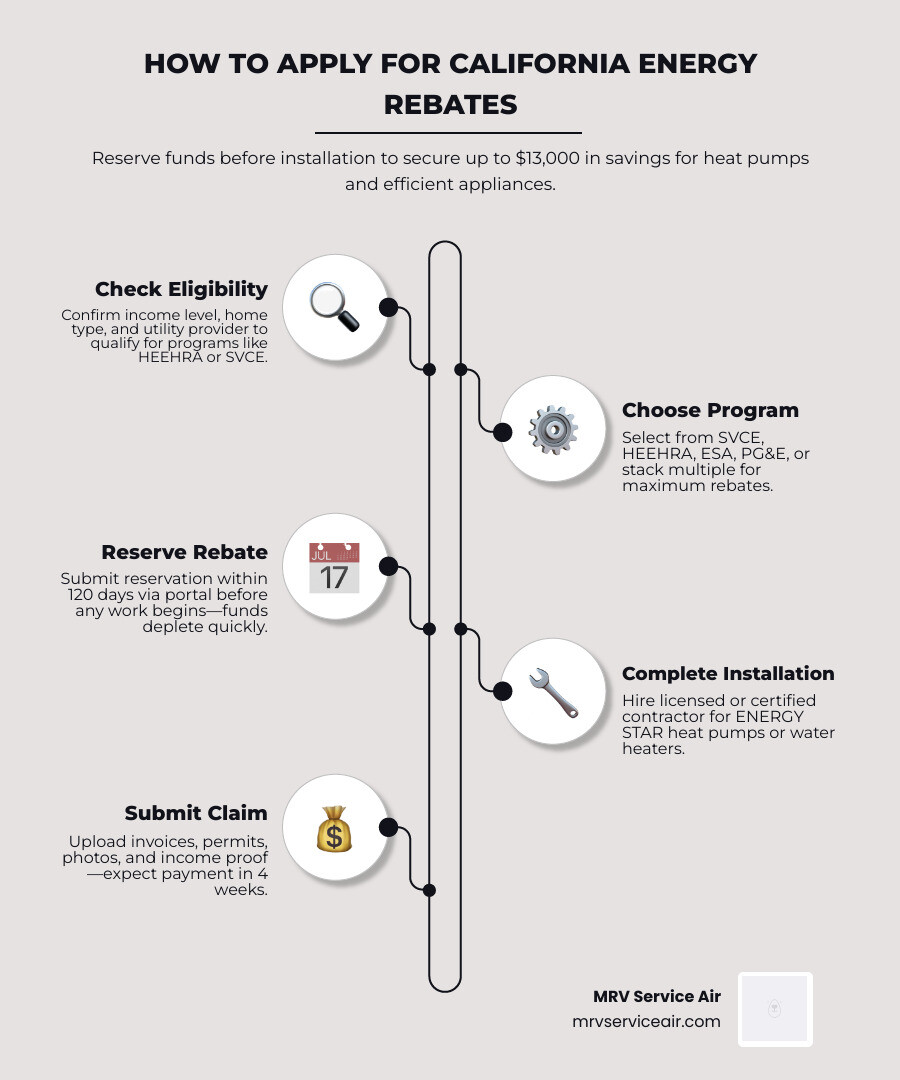
Here is a quick overview of how to apply:
- Check your eligibility — confirm your income level, home type, and utility provider
- Choose your program — SVCE, HEEHRA, ESA, PG&E, or a combination
- Reserve your rebate — submit your reservation before any installation begins
- Complete installation — use a licensed or program-certified contractor
- Submit your claim — provide invoices, permits, photos, and income proof
- Receive payment — most rebate checks arrive within four weeks of approval
The good news is that once you understand the process, it is straightforward. This guide walks you through every step.
Major Energy Rebate Programs Available in California (2026)
Navigating the landscape of energy efficiency services in California can feel like a full-time job. However, as of April 2026, several heavy hitters dominate the rebate scene. The most prominent programs include Silicon Valley Clean Energy (SVCE), the High-Efficiency Electric Home Rebate Act (HEEHRA), PG&E, and the Energy Savings Assistance (ESA) program.
SVCE is a standout for residents in the Silicon Valley area, offering a massive pool of up to $13,000 in total potential rebates for homeowners who go all-electric. Meanwhile, the federal HEEHRA program, part of the Inflation Reduction Act (IRA), has allocated $290 million specifically for California to help residents transition to heat pump technology.
For those looking for smaller, immediate wins, Golden State Rebates provides instant coupons for energy-efficient products like smart thermostats. Whether you are a renter or a homeowner, there is likely a program designed to lower your carbon footprint and your monthly utility bills.
Understanding how to apply for energy rebates in California for heat pumps
When it comes to heat pump services, the financial incentives are particularly aggressive. Heat pumps are essentially the Swiss Army knife of HVAC systems—they handle both heating and cooling with incredible efficiency.
Under current 2026 guidelines, a core rebate of $2,500 is often available for replacing a gas furnace with a high-efficiency heat pump HVAC system. If you are replacing an older electric resistance heater, the rebate is typically around $1,000. For income-qualified customers, these amounts can jump significantly, sometimes reaching up to $3,500 for the HVAC unit alone.
Core rebates for electric appliances
Beyond heating and cooling, California is pushing hard for the electrification of the entire home. This includes:
- Heat Pump Water Heaters: These units are 3 to 4 times more efficient than traditional gas models. You can find rebates of $2,000 for gas-to-electric replacements, or $500 for electric-to-electric upgrades. More info about heating systems can help you decide which model is right for your home.
- Induction Ranges and Cooktops: If you are swapping out a gas range, you could be eligible for a $500 rebate. Even replacing an old electric coil stove with induction can net you $100.
- ENERGY STAR Certification: To qualify for almost any of these rebates, the equipment must be ENERGY STAR certified. This ensures the product meets strict efficiency specifications set by the EPA.
How to Apply for Energy Rebates in California: A Step-by-Step Guide
The secret to a successful application is preparation. You cannot simply buy a unit at a big-box store, install it yourself, and expect a check in the mail. Most programs require a specific sequence of events involving HVAC contractor services and pre-approval.
Reserving your funds before installation
In California rebates, the “reservation” is king. For programs like SVCE, you must submit an application to reserve your funds before the appliance is installed. Once your reservation is approved, it is typically valid for 120 days. This gives you and your contractor a four-month window to get the job done.
We understand that emergencies happen. If your water heater bursts or your furnace dies in the middle of a cold snap, most programs allow for “emergency replacements.” In these cases, you should email the program administrators (such as [email protected]) immediately and note the emergency status on your subsequent application. For standard upgrades, however, always wait for that pre-approval through the central HVAC services portal before signing a contract.
Common mistakes when learning how to apply for energy rebates in California
Even with the best intentions, many homeowners see their claims rejected due to simple errors. Here are the most common pitfalls to avoid:
- Missing Permits: Almost every major energy upgrade requires a local building permit. If you cannot provide a copy of the final, signed-off permit, your rebate will likely be denied.
- Uncertified Contractors: Programs like HEEHRA and TECH Clean California require you to work with specific, “TECH-certified” contractors.
- Retroactive Claims: Attempting to claim a rebate for work done months ago without a prior reservation is the fastest way to get a “no.”
- Incomplete Documentation: You will need “before and after” photos, detailed invoices showing the model and serial numbers, and proof of income if you are applying for enhanced tiers. More info about furnace services can help ensure your equipment meets the necessary specs before you buy.
Qualifying for HEEHRA and Federal Inflation Reduction Act Incentives
The High-Efficiency Electric Home Rebate Act (HEEHRA) is a game-changer for low-to-moderate-income families. Unlike standard utility rebates, HEEHRA is specifically designed to cover a massive portion of the upfront cost for those who need it most.
| Income Tier | AMI Percentage | HVAC Rebate Amount | Max Total Rebate |
|---|---|---|---|
| Low Income | Less than 80% AMI | Up to $8,000 | $14,000 |
| Moderate Income | 80% – 150% AMI | Up to $4,000 | $14,000 |
| Standard Income | Over 150% AMI | $0 (Tax Credits Only) | N/A |
For those in the “Standard” tier, mini-split HVAC systems still offer significant savings through the Federal 25C tax credit, which provides a 30% credit (up to $2,000 annually) for heat pumps.
Current status of HEEHRA Phase I and Phase II
As of early 2026, the demand for these funds has been astronomical. Phase I, which focused on single-family heat pump HVAC systems, saw its initial $290 million allocation fully reserved by February 2024 in many regions. Most areas currently operate on a statewide waitlist.
However, Phase II is currently under development with a fresh $152 million allocation. This phase is expected to expand eligibility and streamline the “point-of-sale” discount process, making it even easier to save. If you are considering ductless HVAC, staying tuned to these updates is vital as new funding tranches are released.
Multifamily property electrification upgrades
It isn’t just single-family homeowners getting the perks. Multifamily properties (buildings with 4 units or fewer often qualify under residential rules) can access up to $14,000 per dwelling unit. These rebates cover more than just the appliances; they also include:
- Electrical Panels: Up to $4,000 for upgrades needed to support new electric loads.
- Wiring/Circuits: Up to $2,500 for the necessary electrical work.
- Planning and Design: Professional planning and design services can often be subsidized to ensure the building’s infrastructure is ready for the 21st century.
Income-Qualified Support through the ESA Program
If your household income falls within certain limits, you might not just get a rebate—you might get the entire upgrade for free. The Energy Savings Assistance (ESA) program is designed for low-income Californians. It provides no-cost weatherization, AC service, and appliance replacements to reduce energy bills and improve home comfort.
Eligibility limits for 2025-2026
Eligibility for the ESA program is generally based on the “250% Federal Poverty Guidelines.” For the current 2025-2026 period (effective through May 31, 2026), the gross annual income limits are:
- 1-person household: $39,125
- 2-person household: $52,875
- 3-person household: $66,625
- 4-person household: $80,375
- Each additional person: Add $13,450
If you participate in public assistance programs like CARE, FERA, or CalFresh, you are often automatically eligible. Proper ventilation work and insulation are frequently included in these no-cost packages.
Free services for renters and homeowners
The ESA program is unique because it is just as accessible to renters as it is to homeowners. Renters simply need written permission from the property owner to allow the upgrades. Services often include:
- Replacing old, inefficient refrigerators with ENERGY STAR models.
- Installing evaporative coolers or high-efficiency cooling systems.
- Weatherization services like caulking, weather-stripping, and attic insulation.
- Improving indoor air quality through duct sealing and filter replacements.
Stacking Rebates and Avoiding Application Scams
One of the most powerful strategies in 2026 is “rebate stacking.” This means you can often combine an SVCE rebate with a federal tax credit and perhaps a city-specific bonus. For example, you might get $2,500 from your utility, $2,000 in federal tax credits, and another $500 from your city for a single heat pump installation.
When you add in “add-on” rebates—like $1,000 for a panel upgrade, $500 for EV pre-wiring, or $500 for total gas meter removal—the savings become massive. Ensuring your duct work is also up to par can further increase your efficiency and long-term savings.
Identifying legitimate IRA-funded programs
With billions of dollars in federal money flowing, scammers have unfortunately entered the chat. To protect yourself, follow these hard rules:
- Look for the Badge: Only work with “TECH-certified” and “HEEHRA-trained” contractors. You can verify these professionals through the Switch Is On contractor finder.
- Never Share Financials Early: Legitimate programs will never ask for your bank account or social security number over the phone or via a random text message.
- Verify the Site: Ensure you are using official portals like
techcleanca.comor your utility’s official.comor.govwebsite.
Verified Rebate Finders:
- ENERGY STAR Rebate Finder (Official EPA tool)
- The Switch Is On (California-specific search by zip code)
- Golden State Rebates (Instant coupons for PG&E/SCE customers)
Upcoming changes and city-specific extras
The rebate landscape is constantly shifting. For instance, SVCE has scheduled significant updates for May 2026. Some rebate amounts may decrease as funding pools shrink, so acting before these deadlines is crucial.
Additionally, check for city-specific bonuses. Residents in Milpitas or Los Altos often receive automatic “extras” on top of their core rebates. Some programs even offer a “gas removal bonus” if you completely disconnect from the gas grid, which can help cover the cost of PG&E’s gas meter removal fee.
Frequently Asked Questions about California Energy Rebates
Can I apply for a rebate after my appliance is already installed?
Generally, no. Most programs require a reservation before installation. The only common exception is for documented emergency replacements (like a failed water heater), but even then, you must contact the program administrators immediately to explain the situation.
How long does it take to receive a rebate check in California?
Once your final claim form—including all invoices, permits, and photos—is submitted and approved, most residents receive their check within four weeks. Some programs are moving toward “point-of-sale” discounts, where the contractor deducts the rebate directly from your invoice, but this is still being rolled out in Phase II of HEEHRA.
Do I need a permit to qualify for an energy rebate?
Yes. Providing a copy of the final, signed-off building permit is a standard requirement for almost all California energy rebates. This ensures the installation was done safely and meets the state’s rigorous energy codes.
Conclusion
Applying for energy rebates in California doesn’t have to be a headache. By choosing the right program, working with a certified contractor, and—most importantly—reserving your funds before you start, you can save thousands of dollars while making your home more comfortable and sustainable.
At MRV Service Air, we take pride in providing prompt, quality service at affordable prices to our neighbors in Delano. Whether you are looking to upgrade your heating system, switch to a heat pump, or simply improve your home’s energy efficiency, our team of experts is here to guide you through the technical requirements and the paperwork.
Don’t let these incentives expire or run out of funding. Reserve your rebates and get a professional quote today to start your journey toward a more efficient, all-electric home.