







Why Heat Pump Advantages Over Traditional HVAC Matter for Your Home in 2026
Understanding the heat pump advantages over traditional HVAC systems can save you money, improve your comfort, and reduce your home’s environmental footprint — all at once. If you’re weighing your options for a new or replacement heating and cooling system, here’s a quick summary of why heat pumps stand out:
Key heat pump advantages over traditional HVAC systems:
- Dual functionality — one system handles both heating and cooling
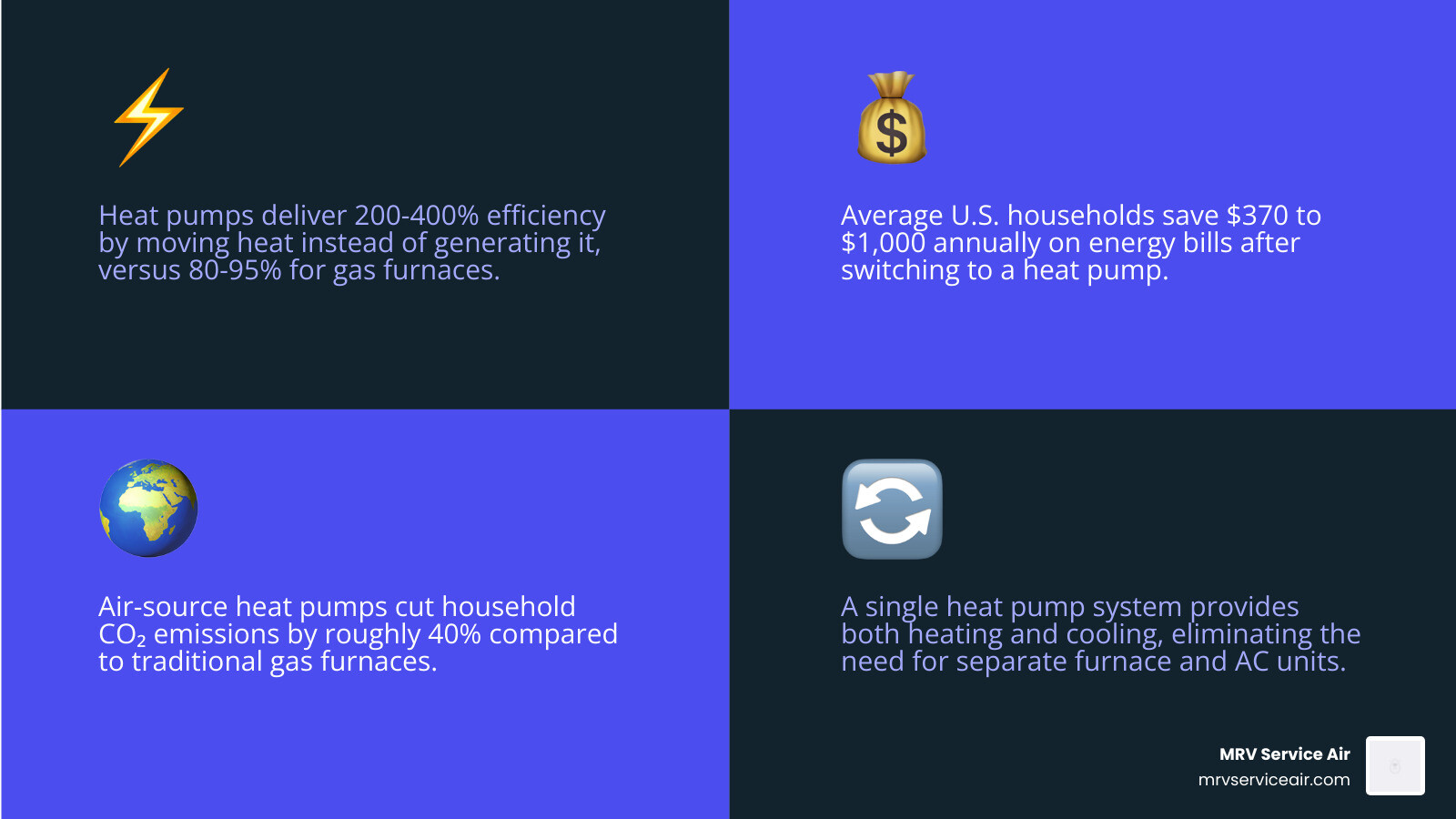
- Higher efficiency — heat pumps are 2 to 4 times more energy efficient than electric resistance or oil furnaces
- Lower operating costs — average households save $370 to $1,000 per year on energy bills
- Reduced emissions — air-source heat pumps cut household carbon dioxide emissions by roughly 40% compared to gas furnaces
- Consistent comfort — variable-speed models maintain steadier temperatures and better humidity control
- No combustion — heat pumps run entirely on electricity, producing no on-site fossil fuel emissions
- Modern cold-weather capability — today’s cold-climate models operate effectively down to -20°F
For most homeowners, the switch to a heat pump is no longer a question of whether the technology works — it’s a question of whether it’s the right fit for your home, climate, and budget. More than 5 million heat pumps were sold in the U.S. in 2024 alone, outselling traditional gas furnaces for the first time. That momentum has only grown heading into 2026.
Whether you’re replacing an aging furnace, an old air conditioner, or both, heat pumps offer a compelling all-in-one alternative that traditional HVAC systems simply can’t match on efficiency or versatility.
Understanding Heat Pumps vs. Traditional HVAC Systems
To appreciate the heat pump advantages over traditional HVAC, it helps to understand how these systems differ at a fundamental level. A traditional HVAC setup typically relies on two separate systems: a central air conditioner to keep you cool in the summer and a combustion furnace (usually burning natural gas or propane) to keep you warm in the winter.
A heat pump, on the other hand, is a single, electricity-driven system that handles both jobs.
Instead of creating heat through combustion or electric resistance, a heat pump uses the refrigeration cycle to move heat from one place to another. In the summer, it gathers heat from inside your home and dumps it outside. In the winter, it reverses the process, extracting heat from the outdoor air and bringing it indoors.
This process is made possible by a specialized component called a reversing valve, which physically changes the direction of the refrigerant flow depending on whether you need heating or cooling.

How Heat Pumps Work in Cooling Mode
In the hot summer months in the Central Valley, a heat pump operates exactly like a standard central air conditioner. It uses a compressor to circulate refrigerant between an indoor evaporator coil and an outdoor condenser.
- Warm air from your living spaces is pulled across the cold indoor evaporator coil.
- The refrigerant inside the coil absorbs the heat from your indoor air, cooling it down.
- This cooled air is then blown back into your home through your ductwork.
- The heat-laden refrigerant travels to the outdoor unit, where the compressor squeezes it, releasing the heat into the outdoor air.
Because a heat pump uses the exact same technology as an air conditioner to cool your home, you do not sacrifice any cooling power or performance. If you are considering alternative setups, such as ductless options for older homes without standard ductwork, you might want to look into whether Is a Mini Split Better Than Central Air for Older Houses? to find the perfect fit for your home’s layout.
How Heat Pumps Work in Heating Mode
The real magic happens when the weather cools down. In traditional HVAC systems, a furnace must burn fossil fuels or use highly inefficient electric heating elements to generate heat. A heat pump, however, simply reverses its cooling cycle.
With the help of the reversing valve, the outdoor coil now acts as the evaporator, absorbing heat from the ambient outdoor air. Even on chilly days, there is still a significant amount of thermal energy present in the outdoor air. The refrigerant absorbs this heat, carries it indoors to the indoor coil (which now acts as the condenser), and releases it into your home.
Because the system is merely moving existing heat rather than generating it from scratch, it is incredibly efficient. To learn more about how this works locally, check out Everything You Need to Know About Your Delano Heat Pump System for a detailed breakdown tailored to our local climate.
Key Heat Pump Advantages Over Traditional HVAC
When comparing a heat pump to a standard furnace-and-air-conditioner combo, several distinct advantages emerge. The following table provides a quick side-by-side comparison of how these systems stack up across key categories:
| Feature | Heat Pump System | Traditional HVAC (Gas Furnace + AC) |
|---|---|---|
| Primary Function | Single system provides both heating and cooling | Two separate systems required |
| Energy Source | 100% Electricity | Electricity (Cooling) + Natural Gas/Propane (Heating) |
| Heating Efficiency | Up to 300% – 400% (COP of 3 to 4) | Max 98% AFUE for premium gas furnaces |
| On-Site Emissions | Zero (fully electric) | Carbon dioxide and combustion byproducts |
| Indoor Comfort | Steady, continuous air delivery with balanced humidity | Intense, hot bursts of air that can dry out the home |
| Maintenance | Bi-annual professional tune-ups (spring and fall) | Annual furnace service + annual AC service |
Understanding Heat Pump Advantages Over Traditional HVAC in Mild Climates
In regions with mild winters, such as the Central Valley of California, heat pumps perform at their absolute peak. Because outdoor temperatures rarely drop below freezing for extended periods, a heat pump can operate in its most efficient zone almost all winter long.
A traditional gas furnace is limited by physics; even the most efficient model cannot exceed 100% efficiency because it must burn fuel to create heat. In contrast, a well-maintained heat pump can deliver three to four times more heat energy than the electrical power it consumes, achieving heating efficiencies of 300% to 400%.
This high coefficient of performance translates directly into lower monthly utility bills. By choosing a heat pump, you are capitalizing on the local climate to maximize your energy savings. For a closer look at how these dynamics apply to our local communities, read The Ultimate Guide to Heat Pump Benefits for Central Valley Residents.
Environmental Benefits and Reduced Carbon Emissions
As California pushes toward a lower-carbon future, reducing residential emissions has become a major priority. Home heating and cooling represent the single largest source of energy consumption and emissions in the average household. By transitioning from a gas-burning furnace to an all-electric heat pump, you can significantly reduce your home’s carbon footprint.
Air-source heat pumps trim household carbon dioxide emissions by about 40% compared with gas furnaces. Because they do not rely on combustion, they also eliminate the risk of carbon monoxide leaks in your home, making your indoor air safer and cleaner.
Furthermore, pairing a heat pump with renewable energy sources, like home solar panels, allows you to heat and cool your home with virtually zero operational emissions. If you want to explore how local programs and incentives can help support this transition, read our guide on How to Save Thousands on California HVAC Upgrades.
Performance, Lifespan, and Maintenance Considerations
Before making the switch, it is important to understand how a heat pump performs over its lifespan and what kind of care it requires to keep running smoothly.
Cold Weather Performance and Cold-Climate Heat Pumps
A common myth surrounding heat pumps is that they do not work when the temperature drops. While it is true that older models struggled in freezing conditions, modern technology has completely rewritten the narrative.
Today’s cold-climate heat pumps feature advanced variable-speed inverter compressors and redesigned refrigerant paths. These innovations allow the system to extract heat from outdoor air even in sub-zero temperatures. Many modern systems can perform well in very low temperatures down to -20°F and provide 100% of their rated heating capacity down to 5°F.
While we rarely experience sub-zero temperatures in places like Bakersfield, we do get chilly winter nights. A modern heat pump handles these temperature drops effortlessly without needing to rely on expensive backup electric resistance heating. For residents in the southern part of the valley, you can find more specific details in our guide, Everything You Need to Know About Your Bakersfield Heat Pump System.
Lifespan and Maintenance Requirements
Because a heat pump provides both heating and cooling, it runs nearly year-round. This continuous operation means it experiences more consistent wear and tear than a standalone furnace, which sits idle all summer, or a standalone AC, which rests all winter.
Typically, a well-maintained heat pump has a lifespan of 12 to 15 years, compared to 15 to 20 years for a standalone gas furnace. To maximize the longevity and efficiency of your heat pump, regular preventive maintenance is essential. We recommend scheduling bi-annual professional tune-ups: once in the spring before the cooling season starts, and once in the fall before the heating season begins.
Staying on top of basic tasks, like changing your air filters every 90 days and keeping the outdoor condenser unit free of leaves and debris, also goes a long way. If your current system is starting to show its age, it helps to understand the decision-making process by reading When to Repair vs Replace Your HVAC System Without Losing Your Cool.
Deciding Between a Heat Pump and Traditional HVAC
Choosing the right comfort system for your home depends on several factors, including your existing infrastructure, your long-term comfort goals, and the unique layout of your property.
When to Choose a Dual-Fuel or Hybrid System
For some homeowners, the transition to an all-electric system can feel like a major leap, or their home’s existing electrical panel might require costly upgrades to support a fully electric heat pump. In these scenarios, a dual-fuel (or hybrid) system offers an excellent middle ground.
A dual-fuel system pairs an electric heat pump with a high-efficiency gas furnace.
- During mild spring, autumn, and winter days, the heat pump handles all the heating, operating at maximum efficiency.
- If temperatures drop below a specific threshold (typically around 30°F to 40°F), the system automatically switches over to the gas furnace.
This setup ensures you always use the most cost-effective and efficient fuel source for the current weather conditions. It provides the energy-saving benefits of a heat pump with the reliable, high-heat output of a gas furnace when you need it most. To understand why upgrading your system is a smart long-term move, check out The Cold Hard Truth: Why HVAC Replacement Is a Smart Investment.
Are Heat Pump Advantages Over Traditional HVAC Worth the Switch?
If you are facing a situation where both your air conditioner and your furnace are nearing the end of their useful lifespans, replacing them with a single heat pump system is often the smartest financial and operational decision. You avoid the hassle of maintaining two separate machines, and you immediately start lowering your monthly utility bills.
Furthermore, installing a highly efficient heat pump can future-proof your home, potentially increasing its resale value. Modern home buyers increasingly look for energy-efficient features, smart home integration, and all-electric utilities. To read more about how these upgrades translate into long-term financial returns, explore Heating Up Your Profits: A Guide to HVAC ROI.
We provide professional heat pump services across several local communities, making it easy to find expert support near you. If you are nearby, check out our dedicated regional resources:
- Everything You Need to Know About Shafter Heat Pump Systems
- Earlimart Heat Pump Services: Why Your Home Needs One Now
- Wasco Heat Pump Services: Your Local Comfort Roadmap
- Finding a Heat Pump Contractor in Richgrove Without Breaking a Sweat
Frequently Asked Questions About Heat Pumps
Do heat pumps work in extremely cold weather?
Yes! While older models struggled when temperatures dropped, modern cold-climate heat pumps are designed to operate efficiently in extreme cold. Many advanced systems can provide reliable heating in temperatures as low as -20°F. In areas that experience prolonged deep freezes, they can be paired with auxiliary electric heat strips or a backup gas furnace in a hybrid configuration to ensure constant comfort.
Can I use my existing ductwork with a heat pump?
In most cases, yes. Central ducted heat pumps are designed to connect directly to your home’s existing ductwork, utilizing the same registers and grilles as your old furnace and air conditioner. During installation, a professional technician should perform a static pressure test to ensure your ductwork can handle the airflow requirements of the new system. If your home lacks ductwork entirely, ductless mini-split heat pumps offer an excellent alternative. To weigh your options, you can read Will a Mini Split Save You More Money Than Central AC?.
How do heat pumps compare to air conditioners in cooling performance?
They are identical. In cooling mode, a heat pump operates on the exact same scientific principles, using the same components (compressor, condenser, evaporator coil, and refrigerant) as a standard central air conditioner. A heat pump with a 16 SEER2 rating will cool your home with the exact same efficiency and power as a standalone 16 SEER2 air conditioner. The only difference is that the heat pump can reverse its operation to heat your home when winter arrives.
Conclusion
The heat pump advantages over traditional HVAC systems make them an incredibly smart upgrade for homeowners looking to future-proof their comfort, slash their utility bills, and reduce their carbon footprint. By serving as an all-in-one heating and cooling solution, a heat pump simplifies your home service needs while delivering unmatched energy efficiency.
At MRV Service Air, we are proud to provide prompt, quality service at affordable prices to our neighbors throughout Delano, CA, and the surrounding Kern and Tulare county communities. Whether you are ready to make the switch to a highly efficient heat pump system or simply need a professional evaluation of your existing HVAC equipment, our experienced team is here to help.
Ready to experience a new level of year-round home comfort? Schedule your heat pump consultation with MRV Service Air today!